


A member can love your studio, attend every week, have enough money to pay, and still produce a recurring-card decline. The problem may have nothing to do with willingness or ability to pay.
Their card may simply have expired, been replaced after suspected fraud, been reissued with a different account number, or changed as part of an issuer account transition.
That is the problem card account updater gym memberships technology and network token lifecycle management are designed to reduce.
Account updater services can make eligible replacement card information available to merchants and their payment providers, allowing stored credentials to be refreshed before a future card-on-file charge.
Network tokens approach the same lifecycle problem differently: instead of relying on the merchant’s recurring workflow to use the underlying primary account number (PAN), a supported payment flow uses a network-issued token whose relationship to the underlying account can be maintained through certain lifecycle changes.
Visa currently describes Visa Account Updater (VAU) as a service for keeping stored credentials refreshed for card-on-file and subscription payments. Mastercard continues to offer Automatic Billing Updater (ABU) for changed account numbers and expiration dates.
Visa separately identifies Visa Digital Credential Updater as a token-lifecycle capability, underscoring that account updating and network-token maintenance are related but distinct functions.
Neither technology eliminates card declines. They primarily help prevent a subset of failures caused by payment credentials becoming stale. Insufficient funds, issuer restrictions, genuine account closures, member-requested blocks, authorization problems, and other declines still require a normal recovery process.
For a studio, the operational objective is straightforward:
stored credential → card lifecycle change → updater or token lifecycle event → member payment record stays current → scheduled dues charge succeeds → unnecessary dunning is avoided.
That is a much better member experience than discovering the stale card only after billing day.
Why Expired and Reissued Cards Cause Membership Autopay Declines
An expired card membership decline is unusual because the underlying customer relationship can still be completely healthy.
Imagine a Pilates member who has attended for two years and pays $149 each month. Her bank identifies suspicious activity on the card and replaces it. She has not canceled the Pilates membership, has sufficient credit available, and expects her next dues payment to run normally.
The studio, however, may still be holding a payment credential associated with the previous card. Unless the payment ecosystem can maintain that credential or deliver replacement information, the next recurring transaction may fail.
Card credentials become stale for several reasons.
| Card Event | What Changes | Potential Autopay Impact |
| Normal expiration | Expiration date may change | Stored credential may become outdated |
| Fraud-related reissue | Card number, expiration date, or both may change | Existing card-on-file reference may no longer authorize |
| Lost or stolen card replacement | Replacement credentials may be issued | Next recurring charge may encounter stale credentials |
| Issuer account conversion | Account credentials can change | Merchant’s existing credential may require lifecycle maintenance |
| Product replacement | Issuer may replace one card product with another | Stored billing credential can require an update |
| Account closure | Account ceases to be usable | Updater may return status information rather than a replacement |
Visa’s current VAU materials explicitly state that a stored Visa credential may be reissued, updated, expired, converted, or closed. Participating issuers can supply eligible changes through the updater ecosystem, and Visa says VAU supports account-number and expiration-date changes as well as closed-account and contact-cardholder recommendations.
That is materially different from an insufficient-funds decline. Updating an expiration date cannot create money in an account. It is also different from a member intentionally canceling a membership or instructing an issuer to block a merchant.
Studios should therefore separate credential lifecycle failure from payment-capacity failure and customer-intent failure in reporting.
The Steady Drip of Card Lifecycle Failures
Card lifecycle events do not normally arrive all at once.
Suppose a studio group has 2,000 active members paying by card. Those cards were issued by many banks at different times. Their expiration dates differ, some members will lose cards, some will experience fraud-related replacements, and some accounts will be converted or reissued.
No unsupported percentage is needed to understand the operating problem:
2,000 active card-on-file members
→ different expiration and reissue dates
→ a recurring stream of credentials becomes stale over time
→ without lifecycle automation, staff discover many of them only when billing fails.
The larger the recurring membership portfolio, the more important credential maintenance becomes as an ongoing process rather than a once-a-year card-cleanup project.
That is one reason a studio’s recurring billing architecture matters as much as its retry sequence. The best failed-payment email is still more work than preventing an avoidable decline in the first place.
How Card Account Updater Works for Gym Memberships
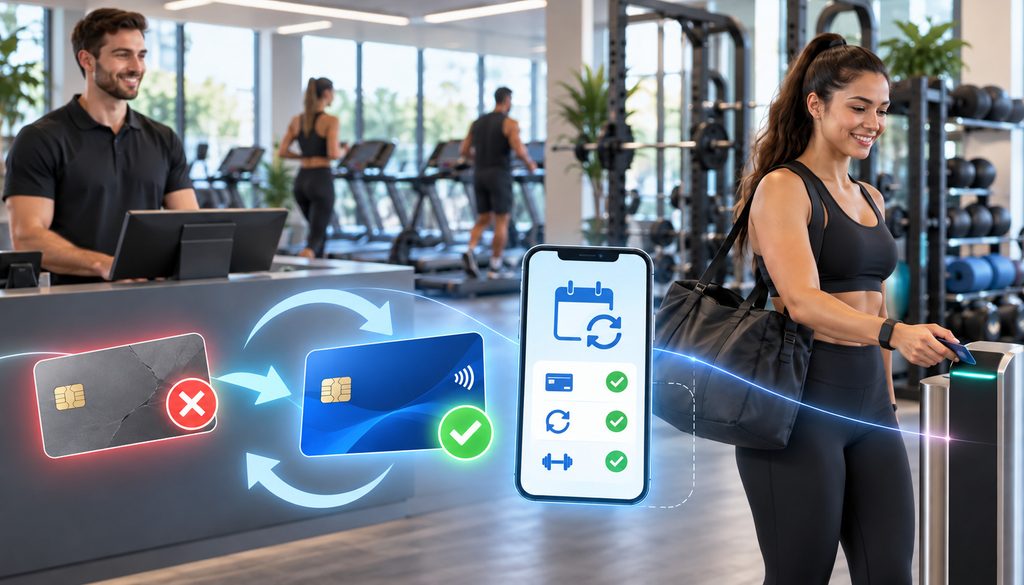
The basic purpose of card account updater gym memberships support is to keep authorized card-on-file credentials usable when eligible account information changes.
Visa describes VAU as an electronic exchange of updated account information among participating issuers, acquirers, and qualified credential-on-file merchants.
Visa’s terms require an appropriate existing card-on-file relationship, and its developer guidance says acquirers should submit inquiries only for accounts where the merchant has an ongoing customer relationship and the customer authorized credential-on-file payments.
Mastercard describes its Automatic Billing Updater as a program through which acquirers and merchants can receive updated payment-account credentials after a card expires or is renewed, while Mastercard’s developer catalog describes ABU as reducing card-not-present declines caused by changed account numbers and expiration dates.
A studio implementation can therefore look like this:
- A member authorizes recurring billing and saves a card through the studio’s supported payment workflow.
- The processor, gateway, vault, or network-supported platform maintains the stored payment reference.
- The issuer later changes eligible account information.
- Updated information becomes available through the applicable network/updater ecosystem.
- The studio’s processor, acquirer, gateway, or other provider requests or receives that information.
- The underlying vault record or logical member payment method is refreshed where supported.
- The next scheduled membership payment uses the maintained credential.
- If authorization succeeds, neither the member nor front-desk staff has to perform a manual card update.
The exact architecture varies substantially. A gym may never interact directly with VAU or ABU. Its processor or gateway may handle enrollment, updater inquiries, vault changes, and billing automatically behind an API or recurring-billing feature.
That is why a studio should ask its processor what actually happens rather than merely asking, “Do you have account updater?”
What Account Updaters Can Refresh
The answer depends on network and provider.
For Visa, current public documentation specifically identifies support for updated account numbers, expiration dates, closed-account responses, and a recommendation to contact the cardholder.
Visa also offers Real-Time VAU, which can identify eligible account changes during the authorization flow and return updated PAN, expiration, or account-status information in supported circumstances.
Mastercard’s current public developer material describes ABU in terms of changed account numbers and expiration dates, while its current ABU privacy notice discusses updated payment credentials after expiration or renewal.
These capabilities should not be interpreted to mean every issuer supplies every possible change or that every merchant receives every replacement credential. Network participation, issuer behavior, geography, merchant eligibility, processor support, and account circumstances all matter.
What Account Updaters Cannot Fix
An updater is credential-maintenance technology, not a universal authorization engine.
| Decline Cause | Updater May Help? | Normal Next Step |
| Expired credential with eligible replacement | Potentially | Use refreshed credential |
| Reissued card with eligible replacement | Potentially | Use refreshed credential |
| Changed account number made available through updater | Potentially | Refresh billing reference |
| Insufficient funds/credit | No | Normal retry or member recovery workflow |
| Issuer authorization decline | Usually not a credential-update problem | Follow issuer/processor decline handling |
| Account closed with no replacement | No | Request another payment method |
| Member intentionally blocked merchant | No | Respect status and investigate appropriately |
| Fraud/security restriction | Not necessarily | Follow issuer/processor guidance |
| Updater unavailable for the card | No automatic solution | Securely request updated payment information |
| Membership actually canceled | Not applicable | Stop billing according to the valid cancellation |
An updater also does not create permission to continue charging a member after authorization has ended.
Recurring billing still depends on the underlying member agreement and applicable card-network stored-credential rules.
Visa’s current rules require a cardholder agreement before storing credentials and require the initial authorization or account verification to succeed before storage. Recurring and other stored-credential transactions must also be submitted using the appropriate transaction framework and indicators.
Studios should also make sure their recurring-payment setup matches the authorization members actually agreed to. Reviewing the rules around gym membership auto-renewal and stored payment information can help separate credential maintenance from the underlying right to continue charging the membership.
Account Updater and Network Tokens: How They Differ
Account Updater and Network Tokens attack closely related card-lifecycle problems from different layers of the payment stack.
An updater is primarily concerned with refreshing information associated with an existing credential.
A network token is a payment credential issued within a card-network tokenization environment and used in place of the underlying PAN in supported transactions.
Visa says Visa Token Service substitutes Visa card numbers with tokens. Mastercard likewise describes network tokenization as replacing sensitive PAN information with network-issued tokens, and its published tokenization materials distinguish network tokens from gateway-issued tokens.
Network Tokens vs. Stored Card Numbers
The distinctions matter operationally.
| Credential Type | What Merchant Stores/Uses | Lifecycle Updating | Security/Operational Characteristic |
| Raw PAN | Actual card account number | Underlying value must be maintained when it changes | Creates direct card-data handling concerns |
| Gateway token | Provider-specific reference to credentials in a gateway or vault | Provider may maintain the underlying credential, potentially using updater services | Reduces merchant handling of raw PAN but can be tied to that provider |
| Processor token | Processor/vault reference to stored payment information | Depends on processor’s lifecycle services | Often useful for recurring billing within that processor’s ecosystem |
| Network token | Token issued within the card-network token ecosystem | Supported lifecycle mechanisms can maintain token/account relationships | Designed to substitute for underlying PAN in supported network flows |
PCI SSC also distinguishes proprietary acquiring tokens from EMV payment tokens. Its guidance explains that acquiring tokens can be created by an acquirer, merchant, or service provider, while EMV payment tokens are supplied in lieu of the PAN and routed through payment networks for transactions.
Network Tokens vs. Gateway Tokens
A gateway token normally means a reference generated by a gateway or vault. The gateway holds or can retrieve the underlying payment credential, while the studio’s application stores a token such as a customer-payment-method identifier.
That token can be extremely useful, but it does not automatically mean the card network itself issued the token.
A network token, by contrast, belongs to the card-network tokenization ecosystem. Mastercard’s published explanation identifies exactly this distinction: network tokenization and gateway tokenization can both protect account information, but the network token is issued through the card scheme rather than merely by the gateway.
These layers can coexist.
For example, Mastercard’s own gateway documentation describes a configuration in which a merchant can continue using a gateway token while the gateway uses an MDES network token rather than the actual card details when submitting eligible transactions.
That illustrates why “our software uses tokens” is not enough information to determine whether a studio has network tokenization.
Why Network Tokens Can Keep Recurring Billing Alive Through Card Changes
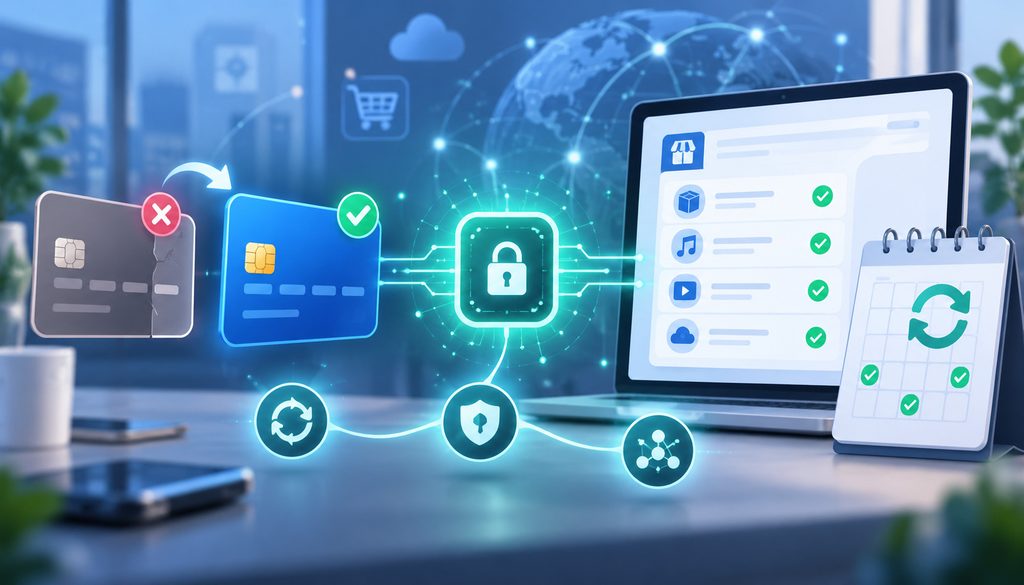
The most important advantage of network tokens recurring billing architecture is lifecycle management.
A cardholder’s physical or virtual card credential can change while the relationship between a network token and the underlying issuer account can, in supported cases, be maintained without requiring the merchant to collect the replacement PAN manually.
Visa currently describes Visa Digital Credential Updater (VDCU) as managing token lifecycles by keeping tokens current and reducing the need to reprovision them when PAN updates occur. Visa’s lifecycle-management materials explicitly place VDCU alongside VAU while treating them as separate products.
Mastercard’s published network-tokenization material similarly describes built-in lifecycle management that can keep tokenized payment relationships current when underlying card details are replaced or expire.
This does not mean every network token survives every reissue.
A token can still become unusable, suspended, deleted, restricted, unsupported for a particular payment flow, or otherwise unable to authorize. Processor implementation and issuer/network lifecycle decisions matter.
The operational principle is narrower:
Underlying card changes
→ network token relationship may be maintained in a supported lifecycle
→ recurring transaction continues using the token
→ member may avoid re-entering a replacement card.
For studios, that can be particularly useful during pauses. A member may freeze an account for six months. During that time the saved card could expire or be replaced. When the membership reactivates, a maintained token or updater-supported credential can reduce the chance that the very first returning payment fails.
Account Updater vs. Network Token
This comparison is central to understanding the two technologies.
| Feature | Account Updater | Network Token |
| Primary purpose | Refresh eligible stale account credentials | Substitute a network-managed token for the underlying card credential in supported flows |
| Typical trigger | Expiration, reissue, account change or other supported lifecycle event | Token provisioning and subsequent token lifecycle |
| Merchant action | Often handled through processor/gateway integration | Often handled through processor/gateway/token service |
| Can reduce expiration/reissue failures? | Yes, where an eligible update is available | Yes, where supported lifecycle management maintains usability |
| Replaces PAN in payment flow? | Not inherently | Yes, in supported network-token transactions |
| Solves insufficient funds? | No | No |
| Solves intentional member cancellation? | No | No |
| Automatically portable between providers? | No | No assumption should be made |
| Relationship to gateway token | Gateway can use updater to maintain vaulted credential | Gateway token may sometimes be backed by a network token |
Do Studios Need Both?
Not necessarily, but the technologies can be complementary.
A processor could use an account updater to maintain traditional card-on-file credentials while also provisioning eligible recurring transactions to network tokens.
Visa itself offers lifecycle-management products spanning PAN-based account updating and digital-token updating. Mastercard gateway documentation likewise shows account-updater maintenance and network-token capabilities coexisting within one provider architecture.
A useful decision framework is:
- Does the processor already maintain saved credentials through account updater?
- Does it support network tokens for the studio’s recurring-payment use case?
- Which card networks and markets are supported?
- Is lifecycle maintenance automatic?
- How does the studio software learn that a credential was maintained?
- What happens when neither mechanism can keep a credential usable?
- How are costs and results reported?
A studio should evaluate the complete workflow rather than purchasing technology solely because “network tokens” appears on a sales sheet.
Which Recurring Declines Updater Services Can Prevent
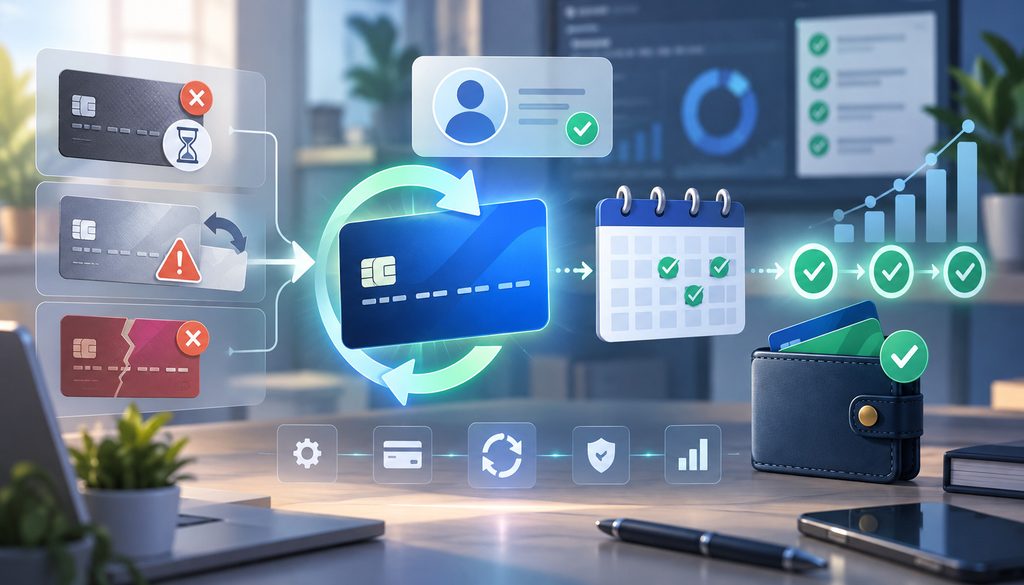
The safest way to measure account-updater value is by decline cause rather than by a generic recovery percentage.
There is no responsible universal statement such as “account updater prevents X% of all membership declines.” The actual share depends on the studio’s issuer mix, networks, processor configuration, geography, number of stale credentials, member behavior, and decline-reason composition.
Updater services can prevent a subset of recurring declines tied to expired or reissued credentials, but the exact share varies by issuer mix, processor, member base, and decline composition.
That distinction is especially important when vendors promote broad approval-rate or retention statistics. A studio should ask what population produced the statistic:
- all recurring transactions,
- only eligible updater inquiries,
- only accounts receiving updates,
- previously declined transactions,
- or a particular processor’s merchant portfolio.
Those are different denominators.
Consider a hypothetical month in which a studio experiences declines for expiration, insufficient funds, fraud restrictions, closed accounts, and miscellaneous issuer reasons. Only the lifecycle-related portion is a realistic updater-prevention pool.
You cannot divide all declines by an industry marketing percentage and assume updater will save that amount.
What Still Needs Post-Decline Dunning
Updater and token lifecycle tools belong before or around authorization. Dunning begins after those prevention mechanisms fail to avoid the actual payment problem.
The distinction should remain explicit.
Prevention Layer
- network tokenization,
- Visa/Mastercard updater support,
- credential lifecycle maintenance,
- appropriate expiration awareness,
- secure stored-credential management.
Recovery Layer
- actual decline detection,
- intelligently configured retries,
- payment-update request,
- member notification,
- staff outreach where necessary.
Suppose an updater has no replacement credential available. The studio runs the scheduled $129 dues charge and receives an insufficient-funds decline. The problem is no longer card lifecycle maintenance; it belongs in the post-decline process.
Likewise, if the issuer returns a restriction or the member blocked the merchant, simply requesting account updates repeatedly is not a recovery strategy.
Once a real authorization attempt fails, the account moves from prevention into recovery. Detailed retry timing, member notices, and staff follow-up belong in a separate failed membership payment recovery workflow rather than being duplicated inside the updater process.
Involuntary Churn From Expired Cards
The business case for lifecycle maintenance is not merely “fewer declines.” It is the prevention of needless member friction.
Involuntary churn expired cards can follow a sequence like this:
Healthy member
→ card becomes stale
→ monthly dues decline
→ member overlooks update request
→ repeated attempt also fails
→ account becomes delinquent
→ membership is placed on hold or terminated
→ member stops attending
→ customer relationship disappears without an intentional cancellation decision.
This is operationally different from voluntary churn.
The member did not wake up and decide to leave. Payment infrastructure inserted a problem into an otherwise functioning relationship.
Preventing that first failure is valuable because each recovery step introduces friction: a decline email, portal login, new card entry, staff follow-up, awkward front-desk conversation, or temporary interruption in class access.
Lifecycle maintenance removes some of those interactions from the system entirely.
How Updater Results Should Flow Into Studio Software
This is where payment infrastructure becomes a studio-operations issue.
A processor can have an excellent updater product and still create front-desk work if its results never reach the membership record in a usable way.
The ideal workflow is:
Updater or token event arrives
→ payment vault/reference is maintained
→ member’s logical payment method remains current
→ lifecycle event is logged
→ billing status remains “ready”
→ next dues charge uses current credential
→ staff sees action required only if automatic maintenance failed.
Staff should not receive a spreadsheet containing replacement card numbers and manually type them into profiles.
| Event | Billing-System Action | Staff Action |
| Updater returns usable credential change | Refresh payment reference/vault record | None normally |
| Network-token lifecycle succeeds | Maintain usable token | None normally |
| Updater indicates contact cardholder | Flag payment method at risk | Secure outreach task |
| No replacement available | Preserve status and flag risk | Ask member for new payment method |
| Scheduled payment succeeds | Mark invoice paid | None |
| Scheduled payment actually declines | Record decline reason | Route to dunning |
| Member securely updates card | Replace/default logical payment method | Verify account is ready |
| Membership resumes after freeze | Validate current payment status | Contact member only if needed |
The same payment status should live alongside freezes, renewals, balances, and other account activity in the studio’s membership management software, rather than being isolated inside a processor dashboard that front-desk staff rarely review.
Silent Credential Updates
A successful automatic card update autopay workflow should normally be boring.
Member’s card changes
→ eligible update is received
→ payment credential is maintained
→ next billing date arrives
→ dues payment succeeds
→ member continues booking classes.
There is often no operational benefit to sending the member a warning simply because the back-end credential changed successfully.
This is not a universal legal statement about every possible notice obligation. Membership agreements, applicable law, payment amount changes, cancellations, and network requirements remain separate considerations.
It simply means a successful maintenance event should not automatically be treated as a billing failure.
Audit Trails and Member Records
The software should preserve enough information to explain what happened without unnecessarily exposing sensitive payment data.
Useful fields can include:
- payment-method status,
- lifecycle/update timestamp,
- updater or token provider/source,
- previous operational status,
- new operational status,
- last four digits where appropriate,
- displayed expiration information where supplied and appropriate,
- network-token status,
- last actual decline reason,
- next scheduled billing date,
- staff action required: yes/no.
Do not put complete old and new PAN values into ordinary application logs, CRM notes, support tickets, emails, or spreadsheets.
A lifecycle log should answer “why was this payment method considered current?” without becoming an unauthorized card-data archive.
Do Not Create Duplicate Payment Methods
An updater event usually concerns the ongoing logical billing relationship. Where the provider architecture supports it, the system should maintain that existing logical payment method instead of creating a growing stack of “Visa ending 1234,” “Visa ending 5678,” and “old Visa” records.
Duplicate methods cause practical problems:
- the wrong one can remain default,
- staff may charge a stale reference,
- member portals become confusing,
- retry logic can hit obsolete credentials,
- reports can double-count payment methods.
The precise method for replacing or maintaining a credential depends on the processor and vault.
When to Ask a Member for a New Card
Automation should eliminate unnecessary outreach, not all outreach.
The studio should consider requesting a secure payment update when:
- updater returns no usable replacement,
- the account is reported closed,
- the provider indicates that the cardholder should be contacted,
- a network token is unusable and no automatic lifecycle resolution is available,
- the payment method is known to be at risk before an imminent charge,
- or the scheduled transaction actually declines and requires recovery.
The message should send the member to a secure, authenticated payment-update flow rather than asking for card details by email or SMS.
A concise message can identify:
- the membership or account,
- the fact that the saved payment method needs attention,
- the billing deadline,
- and a secure portal or processor-hosted update path.
Do not include the full card number.
Upcoming Expiration Reminder vs. Updater
Studios historically sent “your card expires next month” reminders because the member was the only practical source for replacement credentials.
Updater and network-token capabilities can change that workflow.
If automatic lifecycle maintenance is reliable for the relevant credential and a usable update has already arrived, repeatedly asking a member to update the card can generate unnecessary work and confusion.
Proactive expiration reminders may still be worthwhile when:
- the processor does not provide updater support,
- the provider has reported that no usable update exists,
- the next charge is imminent,
- the plan is annual and failure would create a substantial interruption,
- or the studio’s architecture cannot verify lifecycle status before billing.
The right model is exception-based outreach, not indiscriminate messaging.
Avoid False Decline Alerts
Do not tell a member “your payment failed” when no authorization attempt has failed.
If the billing platform performs a lifecycle check before billing, a pending updater result is not a decline.
The software should distinguish:
payment method may need maintenance
from
authorization attempted and declined.
That subtle difference makes member communication more trustworthy.
How Account Updater Fits Into Membership Billing Decline Prevention
A mature membership billing decline prevention stack has several layers.
- Tokenize stored credentials through a qualified payment architecture.
- Enable eligible account-updater services.
- Use network tokens where the processor supports them appropriately.
- Keep upcoming-expiration awareness available for exceptions.
- Maintain a secure member self-service payment-update path.
- Preserve meaningful authorization decline reasons.
- Apply the post-decline retry and dunning workflow only after the prevention layer has finished.
This is particularly useful for monthly, annual, paused, and reactivated memberships.
Monthly vs. Annual Memberships
Monthly memberships transact frequently. If a credential becomes stale, the problem tends to surface quickly.
Annual memberships may go much longer without a transaction. A member can replace a card many months before renewal and completely forget that the studio has an older credential.
That makes pre-renewal credential health especially important for annual memberships, even though no universal failure-rate assumption should be applied.
Freeze and Pause Memberships
A freeze creates a similar dormant period.
Consider this sequence:
Member freezes in January
→ card is replaced in April
→ membership reactivates in July
→ old payment credential would otherwise be used.
A token-lifecycle or updater-supported system may already have maintained the credential. If not, the software can identify the payment method as at risk and request a secure update before attempting the reactivation charge.
Member Reactivation
A reactivation workflow should therefore include:
membership becomes billable
→ confirm current logical payment-method status
→ use maintained credential/token where available
→ otherwise request a secure update
→ then initiate authorized recurring billing.
It should not assume that a payment method saved six or twelve months earlier remains usable merely because the record still exists.
How Account Updater Fits Into the Billing Calendar
There is no universal updater schedule that every studio should copy.
Providers can process lifecycle updates through scheduled files, batch processes, real-time authorization integrations, processor-managed services, or event-driven token lifecycle systems.
Visa, for example, publicly describes both traditional VAU inquiry workflows and Real-Time Visa Account Updater. Its acquirer guidance gives an example in which merchants billing monthly may submit accounts scheduled for payment in the coming days, but that is not a rule that every studio must independently implement.
A studio-level calendar might therefore look like this:
Illustrative only
7 days before billing: provider lifecycle/update process is allowed to run where supported.
Before billing: software checks whether the logical payment method requires member action.
Billing day: maintained credential or network token is charged.
After an actual decline: normal retry/dunning begins.
Your processor may use a completely different cadence.
The question to ask is not “Does updater run seven days before billing?” It is:
“Will an eligible update be applied in time for our next scheduled recurring transaction, and how can we verify that?”
Pricing, Update Frequency, and ROI
Updater pricing is provider-specific.
Potential commercial structures can include:
- a fee per successful update,
- a fee per inquiry,
- inclusion within a recurring-billing package,
- processor-level pricing,
- or another bundled arrangement.
Do not assume a provider’s fee model from another processor’s quote.
A simple ROI framework is:
Monthly updater cost
compared with
preventable lifecycle failures × dues value × payments actually retained because the lifecycle problem was avoided
Then add the administrative benefit of avoiding:
- staff follow-up,
- payment-update conversations,
- billing-support tickets,
- repeated attempts,
- membership holds,
- and reconciliation work.
Hypothetical ROI Example
Suppose a studio spends a hypothetical $90 per month for a lifecycle-maintenance feature.
During one month, its reporting identifies 12 actual member credentials that were updated before scheduled billing. Those 12 members each owed $125.
That does not mean the service automatically “saved $1,500.” Some of those underlying cards might still have authorized through another lifecycle process, and not every update proves a decline would otherwise have happened.
The useful calculation is therefore:
- Identify verified lifecycle events.
- Determine which accounts would otherwise have had an unusable credential, where the data supports that conclusion.
- Track whether the next authorized payment succeeded.
- Compare retained payments and avoided recovery work with service cost.
This avoids turning correlation into fake ROI.
What to Ask Your Processor About Updaters and Token Support
The processor conversation should go beyond a yes/no feature checklist.
| Question | Why It Matters | Desired Capability |
| Is account updater enabled automatically or optional? | Studios may assume they have a feature that was never activated | Clear enrollment status |
| Which card brands are supported? | Coverage can vary | Brand-by-brand answer |
| Is it enabled for recurring/card-on-file transactions? | Generic updater support may not equal your billing use case | Explicit recurring support |
| How and when are accounts checked? | Determines whether updates arrive before billing | Documented provider workflow |
| Is pricing per inquiry, update, or bundled? | Required for ROI calculation | Transparent billing basis |
| How do results reach studio software? | Prevents manual operations | Automatic vault/member-record integration |
| What happens when no replacement exists? | Determines outreach workflow | Clear exception status |
| Are results reportable by MID/location? | Important for groups | Location-aware reporting |
| Do you support network tokenization? | Distinguishes basic vault tokenization from network tokens | Clear Visa/Mastercard capability |
| Are recurring cards automatically provisioned where eligible? | Determines actual adoption | Defined provisioning process |
| How are token lifecycle failures surfaced? | Needed for exception handling | Actionable status/API/report |
| What happens during processor migration? | Stored credentials may not be portable | Documented migration plan |
Enrollment and Card-Brand Coverage
For Visa specifically, merchant participation is not merely an informal technical switch. Visa’s current developer documentation states that acquirers determine merchant eligibility and enroll appropriate merchants, and Visa limits VAU to qualifying credential-on-file models subject to product restrictions.
Ask:
- Are we actually enrolled?
- Under which merchant IDs?
- Which locations are included?
- Which network programs are active?
- Are all recurring billing environments pointing to the enrolled processor path?
A multi-location group with separate merchant IDs should not assume activation on Location A proves activation on Locations B through F.
Pricing and Update Frequency
Ask the processor to describe its real production workflow:
- batch or real time?
- scheduled or event driven?
- inquiry before upcoming recurring transactions?
- vault maintenance performed automatically?
- any action required from the studio software?
- how quickly does an update become available to the billing engine?
Avoid insisting that every provider match a particular timetable. Network products themselves can support different mechanisms, and provider implementations differ.
Network Token Support
Ask:
- Do you support network tokenization for recurring card-on-file billing?
- Which card networks are supported?
- Is provisioning automatic or opt-in?
- Is our merchant configured as a token requestor, or is the processor acting in that role?
- How are recurring payments submitted using network tokens?
- How are lifecycle updates applied?
- What happens when a token becomes suspended or unusable?
- How does the software distinguish a gateway token from the underlying network-token capability?
- What reporting is available?
Visa’s Visa Token Service and Mastercard’s official tokenization overview provide first-party descriptions of their respective token ecosystems.
Token Portability and Processor Migration
Do not assume a saved credential can simply be exported from Processor A and imported into Processor B.
Gateway and processor tokens are often provider-specific. Network-token migration also depends on the token-requestor, network, processor, vault, and migration architecture.
That makes updater and token support a pre-migration requirement, not something to investigate after the switch.
Before moving thousands of memberships, ask the replacement provider:
- Which stored credentials can legally and technically migrate?
- Which credentials require reprovisioning?
- What happens to gateway tokens?
- What happens to existing network tokens?
- Will members have to re-enter payment information in any cases?
- When does updater enrollment become active on the new merchant configuration?
- Can billing be tested before the old environment is retired?
Payment credentials should also be treated as a dedicated workstream within a broader studio software migration. Membership records may transfer correctly while gateway tokens, network-token relationships, or updater enrollment still require separate validation.
A migration that loses credential-lifecycle support can create a cluster of avoidable declines even if membership records themselves import correctly.
Security, Tokenization, and PCI DSS
As of September 2026, the PCI Security Standards Council’s document library identifies PCI DSS v4.0.1 as the current featured PCI DSS version.
Tokenization can reduce exposure to raw card data, but it does not make PCI obligations disappear automatically.
PCI SSC’s tokenization guidance states that tokenization can potentially reduce the number of systems subject to PCI DSS when properly implemented and segmented, while the tokenization systems, detokenization components, cardholder-data environments, and other connected systems can remain in scope.
Studios should therefore:
- avoid collecting or logging raw card numbers unnecessarily,
- use processor-hosted or appropriately secured payment-entry methods,
- restrict staff payment-data access,
- avoid full PANs in member notes, emails, chats, or spreadsheets,
- understand which provider stores the underlying credential,
- and validate PCI scope based on the actual integration.
Do not choose an SAQ solely because “we use tokens.” PCI scope depends on architecture.
The PCI Security Standards Council document library is the appropriate source for current PCI DSS materials.
Member Consent and Stored Credentials
Credential lifecycle maintenance should sit inside an existing authorized stored-credential relationship.
It does not give a studio permission to charge an amount, schedule, membership, or customer relationship that was never authorized.
Visa’s current VAU terms define the service around recurring and credential-on-file relationships, while its developer guidance requires an ongoing customer relationship and authorized card-on-file payments for updater inquiries.
Similarly, card-network recurring and merchant-initiated transaction frameworks continue to govern how subsequent charges are identified and processed.
The operational rule is therefore:
authorization governs whether you may bill; lifecycle maintenance helps keep the authorized credential usable.
Do not treat a silent updater event as “new consent.” It is a payment-credential maintenance event within the existing relationship.
Likewise, do not continue billing merely because an updater supplies new credentials after the member has validly canceled the underlying payment arrangement.
Reporting on Involuntary Churn From Expired Cards
A studio cannot improve membership billing decline prevention if it only measures total collected revenue.
Lifecycle reporting should connect prevention with downstream outcomes.
| Metric | Calculation/Definition | Why Track It |
| Credential lifecycle events | Count of identifiable updater/token maintenance events | Shows actual maintenance activity |
| Updater successes | Credentials refreshed through updater where provider identifies the event | Measures account-updater activity |
| No-update results | Eligible inquiries without usable replacement | Identifies outreach risk |
| Expiration/reissue declines | Actual declines classified as stale-credential related where supported by processor data | Estimates remaining lifecycle failures |
| Post-updater declines | Accounts with lifecycle processing that later fail authorization | Separates maintenance from payment success |
| Dunning avoided | Accounts demonstrably maintained before billing that otherwise would have entered exception handling, where measurable | Evaluates operational value |
| Dunning recovered | Actual failed accounts later paid through recovery | Measures recovery layer |
| Still unpaid | Failed accounts not recovered | Identifies revenue exposure |
| Involuntary churn | Members ultimately suspended/canceled following unresolved payment failure | Connects payment operations to retention |
Decline Reason Mix
Separate, where processor data permits:
- expired card,
- invalid account,
- insufficient funds,
- generic/do-not-honor,
- lost/stolen or security-related status,
- account closure,
- and other processor-specific reasons.
Do not assume every code tells you the issuer’s precise rationale. Processor mappings and network responses vary.
The goal is segmentation, not false certainty.
Do Not Count Every Saved Autopay as Updater Success
If 1,800 memberships bill successfully, that does not mean updater “saved” 1,800 payments.
Most may have required no lifecycle intervention at all.
Measure actual updater events or token-lifecycle events where your provider exposes them.
Then separately measure authorization success.
This distinction prevents inflated vendor ROI reporting.
The Full Involuntary-Churn Funnel
A useful monthly funnel is:
members scheduled for card billing
→ credential lifecycle events identified
→ accounts maintained before billing
→ actual billing declines
→ dunning recoveries
→ still unpaid
→ suspended/canceled memberships.
That connects prevention and recovery without pretending they are the same mechanism.
Payment-lifecycle reporting is most useful when it connects to broader membership management, billing, and retention workflows, so operators can see whether an unresolved payment problem eventually becomes a membership suspension or cancellation.
Multi-Location Studio Groups
Multi-location operations add another layer because payment architecture may differ by site.
One company may have:
- separate merchant IDs per location,
- one centralized membership database,
- shared processor relationships,
- different legacy gateways,
- or acquired studios still using old billing environments.
Create a location-by-location matrix showing:
Location → MID → gateway → updater enabled? → network tokens supported? → reporting source → exception owner.
The objective is consistency.
If six studios share a CRM but only four merchant configurations receive updater maintenance, enterprise-level reporting could conceal problems at the remaining two locations.
Multi-location operators should also determine whether lifecycle events are reported centrally and whether member movement between locations changes the payment credential or merchant relationship.
Common Account Updater and Tokenization Mistakes
| Mistake | Risk | Better Approach |
| Assuming updater is automatically enabled | Stale cards continue failing unnoticed | Verify enrollment by merchant ID |
| Assuming every issuer/account will update | Staff expects impossible coverage | Maintain exception handling |
| Calling every vault token a network token | Incorrect architecture assumptions | Ask who issues the token |
| Sending expiration reminders to everyone | Creates unnecessary member friction | Use exception-based messaging where possible |
| Manually editing sensitive card data | Security and operational risk | Use provider-managed secure update flows |
| Failing to connect updater results to member records | Processor automation still creates staff work | Integrate lifecycle status into billing software |
| Creating duplicate payment methods after updates | Wrong credential may remain default | Maintain the existing logical method where supported |
| Assuming network tokens solve insufficient funds | Misroutes recovery effort | Separate credential failures from funding failures |
| Ignoring migration support | New processor may lose continuity | Validate updater/token migration before cutover |
| Measuring every successful charge as updater recovery | Inflates ROI | Identify actual lifecycle interventions |
| Treating an updater result as new billing consent | Confuses credential maintenance with authorization | Preserve original authorization logic |
Practical Studio Autopay Preservation Workflow
A practical studio workflow can be implemented in this order:
- Confirm processor account-updater support: Identify the actual network programs and provider service involved.
- Confirm supported card brands and markets: Do not infer universal coverage.
- Confirm network-token support: Determine whether recurring transactions can use network tokens rather than merely gateway tokens.
- Ensure authorized recurring memberships use securely tokenized stored credentials.
- Connect updater and token lifecycle events to member records.
- Log lifecycle events without placing unnecessary sensitive data in application logs.
- Allow successful maintenance events to flow without manual front-desk intervention.
- Attempt the authorized membership charge on its normal billing date.
- If payment succeeds, continue the membership normally.
- If no usable replacement credential exists, request a secure payment-method update.
- If authorization fails for another reason, route the account to normal dunning.
- Track updater-resolved and dunning-recovered accounts separately.
- Review expiration/reissue decline trends by location and processor.
- Re-evaluate updater and token support before any processor or gateway migration.
That sequence keeps credential maintenance ahead of recovery instead of treating every stale card as a collection problem.
Studio Autopay Card-Lifecycle Checklist
- Confirm account updater enrollment.
- Confirm supported card brands and relevant markets.
- Confirm whether recurring payments can use network tokens.
- Determine whether existing software tokens are gateway, processor, or network tokens.
- Verify recurring memberships use appropriately secured stored credentials.
- Ask how account changes enter the processor vault and studio billing system.
- Avoid manual handling of full sensitive card data.
- Log updater/token lifecycle events securely.
- Preserve lifecycle timestamp, source, status, and next billing date where available.
- Distinguish updater success from authorization success.
- Allow successful updates to proceed without unnecessary member interruption.
- Create a secure outreach task when no valid credential can be maintained.
- Avoid sending a “payment failed” notice before an actual failed payment attempt.
- Route true authorization failures into the normal dunning process.
- Track expired/reissue-related decline reasons separately where possible.
- Track actual updater-resolved member accounts.
- Track post-updater declines and residual involuntary churn.
- Review support separately for every MID in a multi-location group.
- Check dormant credentials before annual renewals and membership reactivations.
- Revalidate updater and network-token support before changing processors.
Frequently Asked Questions
What is a card account updater for gym memberships?
A card account updater is a payment-network-supported service that can make eligible changed card credentials available to processors, acquirers, gateways, or credential-on-file merchants. It can help keep authorized gym and studio recurring billing current after events such as expiration or reissue.
How does an account updater know a member got a new card?
Participating issuers provide eligible account changes through the applicable network updater ecosystem. The processor, acquirer, gateway, or merchant-supported integration can then request or receive those changes. Exact architecture differs by provider.
Can an updater change the expiration date automatically?
It can in supported cases. Visa publicly states that VAU supports account-number and expiration-date updates. Mastercard describes ABU as supporting changed account numbers and expiration dates. Availability for a specific account is not guaranteed.
Does account updater work when a card is replaced after fraud?
It may, if the issuer supplies an eligible replacement through the updater program and the processor/merchant configuration can receive it. Do not assume every fraud-related replacement will produce an update.
What is a network token in recurring billing?
A network token is a network-issued payment credential used in place of the underlying PAN in supported payment transactions. It differs from a simple gateway vault reference because it participates in the card network’s tokenization ecosystem.
Is a network token the same as a gateway token?
No. A gateway token normally references card data held by a gateway or processor vault. A network token is provisioned through the card-network token ecosystem. A gateway can sometimes use a network token behind its own gateway-token interface.
Can network tokens survive card reissues?
Certain token lifecycle systems can maintain token usability through supported underlying card changes. Visa, for example, describes VDCU as keeping tokens current when PAN updates occur. That does not mean every token survives every replacement scenario.
Do network tokens prevent all membership declines?
No. They cannot make an account with insufficient funds suddenly fund a transaction, override legitimate issuer restrictions, reverse a member cancellation, or guarantee authorization.
What kinds of declines can account updater prevent?
Primarily credential-lifecycle failures where eligible replacement information is available—for example, some expiration and reissue scenarios. It is not designed to cure every issuer decline.
What happens if no updated card is available?
Flag the payment method as requiring attention and send the member through a secure payment-update process. If the scheduled transaction has already failed, move the account into the normal recovery workflow.
Should I email members before their cards expire?
Not automatically in every case. If updater or token lifecycle maintenance has already kept the credential usable, unnecessary reminders can create friction. Proactive reminders remain useful when automatic maintenance is unavailable or the upcoming payment is genuinely at risk.
How should updater results appear in studio software?
Ideally, the logical payment method updates automatically and the member record receives a secure lifecycle event showing status, timestamp, source, next billing date, and whether staff action is required. Staff should not need to handle a replacement PAN manually.
Does account updater cost extra?
It depends on the processor. Pricing may be per inquiry, per successful update, bundled into a platform, or handled through another processor pricing model. Get the commercial terms in writing rather than assuming a standard industry rate.
How often does account updater run?
There is no single universal cadence. Implementations may be scheduled, batch-based, real time, event driven, or processor managed. Visa supports both updater inquiry workflows and Real-Time VAU. Ask your provider how its actual production workflow aligns with your billing schedule.
What should I ask a processor before switching membership billing?
Confirm updater enrollment, supported networks, recurring-payment eligibility, network-token support, token provisioning, lifecycle management, vault migration, credential portability limitations, reporting, pricing, and what happens to unresolved credentials during cutover. Do this before moving the recurring portfolio.
Conclusion
Expired and reissued cards can cause preventable membership failures even when the member has every intention of staying.
Account updater services such as Visa Account Updater and Mastercard Automatic Billing Updater can help keep eligible card-on-file credentials current when card information changes.
Network tokens provide a different layer of continuity by replacing the underlying PAN in supported payment flows and allowing token lifecycle management to address certain underlying credential changes.
Neither approach eliminates every decline. Insufficient funds, issuer restrictions, closed accounts without usable replacements, security controls, member-requested blocks, and other authorization problems still require appropriate recovery.
For studios, the strongest implementation is operational rather than merely technical. A successful lifecycle event should refresh the usable payment reference, update the member record, create a secure audit event, and allow the next scheduled dues charge to proceed without front-desk employees touching card data.
Member outreach then becomes exception based: contact someone when automatic credential maintenance cannot keep the payment method usable, not merely because a card lifecycle event occurred.
When evaluating processors, compare updater enrollment, network coverage, token support, software integration, pricing, reporting, lifecycle cadence, and migration behavior. That is how Account Updater and Network Tokens become practical membership-retention infrastructure rather than another checkbox on a payments feature list.