

Picture this. A former instructor files a wage claim against your studio. She says she was paid only for the 45 minutes she spent teaching each class. Not the prep. Not the playlist building. Not the room setup or the after-class client texts. Now the U.S. Department of Labor wants three years of your time records. The question is simple. Do you actually have them?
This isn’t an isolated incident, and it has happened with larger fitness brands. Smaller studios and boutique gyms, yoga and spinning studios, also run on an hourly work basis. Along with that, federal regulations also come into play. The positive side is that if you have a good understanding of what the laws are, it is not difficult to have accurate FLSA time records. The following guide will explain what time records you should be tracking, and for how long, as well as the common pitfalls for studios.
What the FLSA Requires From Fitness Studios
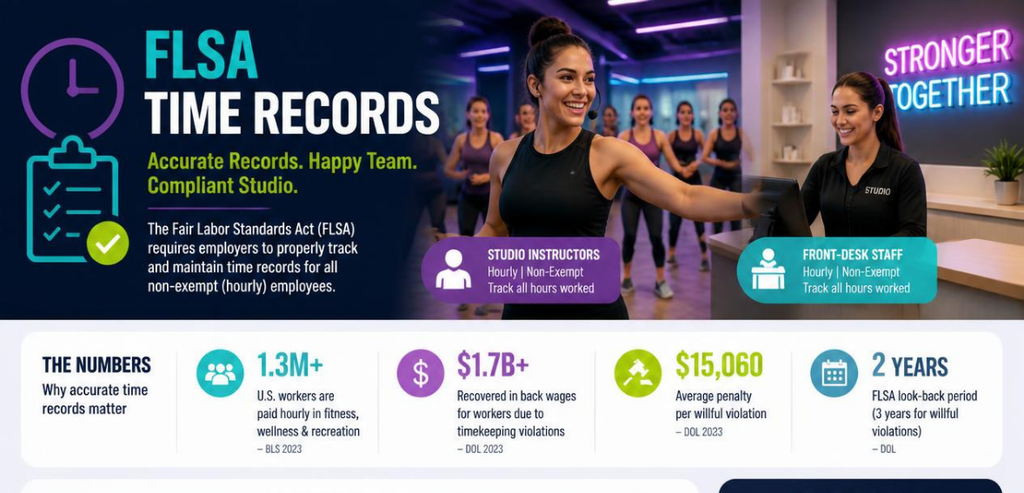
The Fair Labor Standards Act (FLSA) is the federal law that sets minimum wage, overtime pay, and recordkeeping standards across the United States. If your studio has hourly workers, it almost certainly applies to you. The law is enforced by the Wage and Hour Division of the Department of Labor.
The FLSA has two primary effects. It obligates payment to non-exempt employees for every hour worked at no less than the federal minimum wage. It mandates payment for hours worked over 40 in a week at a rate of 1.5 times the regular pay. A workweek is any fixed and recurring block of seven days. To prove the required payment has been satisfied, accurate records of each non-exempt employee’s work hours must be maintained by the fitness studio.
One particularly flexible feature of the law is appreciated by most owners. The FLSA does not dictate the method of recordkeeping. Timesheets, punch clocks, timesheet software, etc. can all be used to achieve compliance, as long as the records are complete and accurate. The DOL Fact Sheet #21 can be consulted for a summary of the recordkeeping provisions of the FLSA.
Who Counts as Non-Exempt in Your Studio
Recordkeeping rules apply mainly to non-exempt employees. In a fitness studio, that is most of your team. Hourly instructors, per-class group fitness teachers, personal trainers on an hourly rate, and front-desk staff are almost always non-exempt. That means they earn overtime and their hours must be tracked.
Some owners think that hiring a manager or lead trainer will keep them safe from overtime lawsuits. This belief can be very costly to owners. To qualify for exempt status for overtime pay, the employee needs to earn at least $684 on a salary basis (equivalent to $35,568 yearly) and also pass a duties test. This salary represents the federally accepted figure since the DOL, in a technical amendment in May 2026, restored the 2019 threshold. If a studio manager earns less than $684 per week and spends the majority of their workday answering phone calls at the front desk and teaching classes, they fail the duties test and are considered non-exempt.
Just a friendly warning about independent contractors: calling an instructor a “1099 contractor” does not remove the wage and overtime regulations. Misclassification of employees is the top reason studios are audited, and being forced to reclassify employees correctly will result in owed back wages, overdue taxes, and penalties. The best course of action is probably to consider this instructor an employee.
The Time Records Every Studio Must Keep
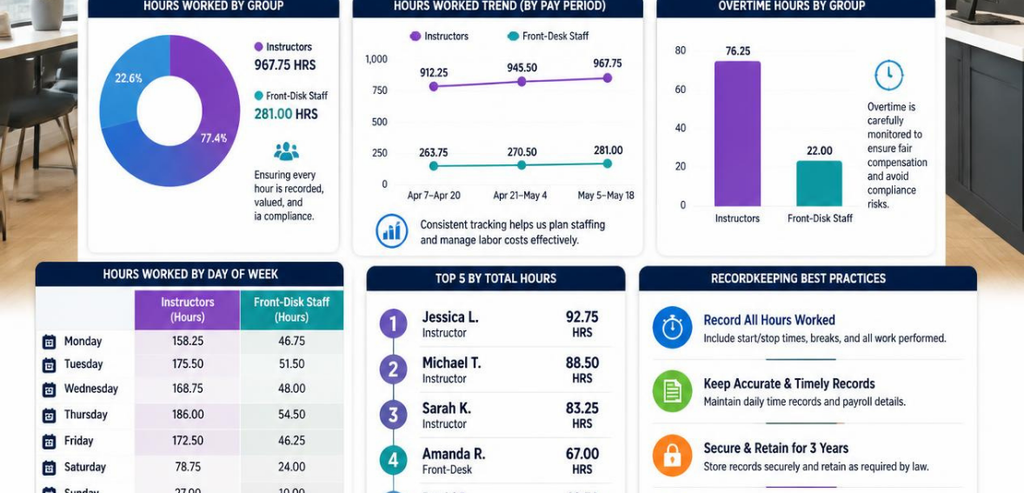
Here is the one part of this guide worth printing and pinning to your office wall. Federal law spells out the basic pieces of information you must maintain for each non-exempt worker. These are the required wage records and time records for your studio:
- Employee’s full name and Social Security number
- Home address, including zip code
- Birth date, if the worker is younger than 19
- Sex and occupation
- The time and day of the week when the employee’s workweek starts
- Hours worked each day and total hours worked each workweek
- The basis on which wages are paid, such as “$22 per class” or “$18 per hour”
- Regular hourly pay rate
- Total daily or weekly straight-time earnings
- Total overtime earnings for the workweek
- All additions to or deductions from wages
- Total wages paid each pay period, plus the date of payment and the pay period it covers
That list represents the minimum requirements for compliance, not preferences. Failure to track the required daily and overtime hours will leave a noticeable gap for an investigator. 29 CFR Part 516 is the federal regulation associated with these requirements. It’s a good idea to bookmark this regulation for the complete legal text.
How Long to Keep Fitness Studio Employee Time Records
Keeping records is only half the job. You also have to keep them long enough. The retention rule has two tiers, and mixing them up is a common mistake.
Payroll records must be kept for a minimum of three years. This includes totals of wages, pay dates, and the basic employee information mentioned above. The other records that document your pay calculations must be kept for two years. This includes all records that constitute your wages, including time cards, work and time schedules, and records of wage additions and deductions.
Take it easy and store all records for three years, and there will be no concern about clearing either bar. Storage costs are much smaller than the cost of a single wage dispute. Records may be stored at your studio or a central office, but must be available to Department of Labor representatives upon request.
Off-the-Clock Work: The Biggest Trap for Instructors
This is where fitness studios get burned. Many pay only for the “billable” unit, the class or the session. They ignore everything wrapped around it. That is a serious problem under the FLSA.
Consider a day in the life of a group fitness instructor. Since a fitness instructor’s day usually starts before the sun comes up, many aspects of an instructor’s day are built around prep, like setting up a sound system, building playlists, logging attendance, and answering questions. There’s a long list of other tasks an instructor handles after a class that are built around communication and the prep that must be done before a client meeting. Once the client meeting is over, the instructor has finally reached the end of the listed obligations for the day. Every task that has been listed here is paid work time, and some of that time may be overtime.
Recent high-profile legal cases involving national spinning and gym chains have highlighted the claims of class instructors who have alleged that the only time they were being paid was when they were teaching and in the prep time, requiring them to work dozens of hours outside of class time. The outcome of the cases should be a clear and simple instructive model for every studio owner. Time tracking to the minute for prep and class time is finally the answer. A completed “clock in” and “clock out” for each task and each step of the prep fulfills the time tracking obligation.
Tracking Multi-Rate Pay for Cross-Trained Staff
Studios love versatile people. A front-desk employee might also teach a Saturday class. A trainer might cover the desk during a slow afternoon. This flexibility is great for scheduling and terrible for sloppy payroll.
Overtime calculations can get complex when an employee earns two pay rates in a single workweek. First, you cannot just pay overtime using the lesser of the two rates. Under the FLSA, a ‘blended rate’ or weighted average of the rates must be calculated. Then, the time-and-a-half premium is computed based on that rate. You must keep records of the actual time worked at each rate. If time records are not kept, the payroll calculations cannot be defended. You must track work hours at each pay rate and by each job role, every week.
Choosing a Timekeeping Method That Holds Up
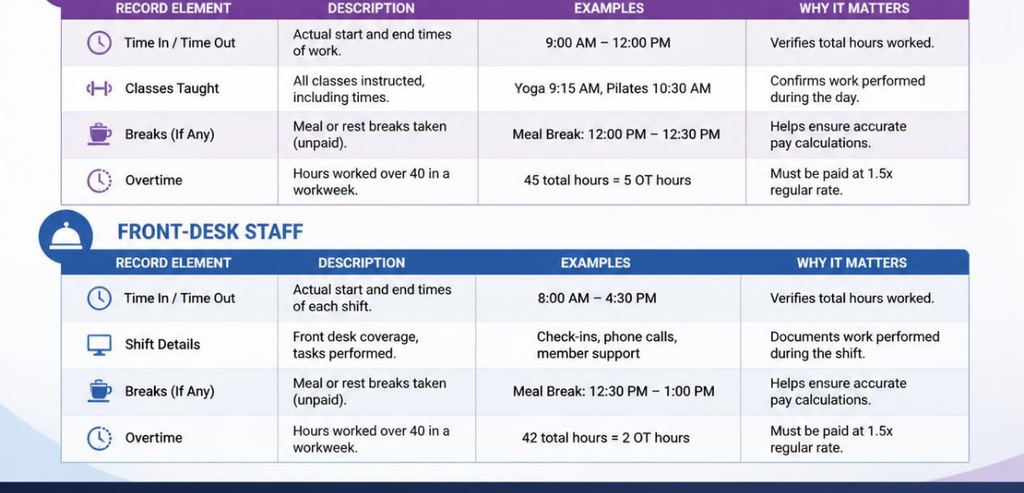
Since the law does not mandate a format, you get to choose the tool that fits your studio. The only real requirement is that it captures accurate, complete hours for every non-exempt worker. Paper timesheets work if they are filled out honestly and consistently. Most growing studios move to digital tools because they reduce errors, track multiple pay rates, and store records in one place for the full retention period.
A few well-known options illustrate the category, and studio owners should compare features against their own workflow before committing.
Homebase
Homebase is a scheduling and time-tracking platform aimed at small hourly teams. It offers mobile clock-in and clock-out, timesheet exports, and basic labor tracking, which suits studios where staff punch in for shifts and classes.
Netchex
Netchex is a payroll and HR platform designed for variable-hour and multi-rate workforces. This fits well with fitness companies where trainers receive hourly pay plus session pay and where front-desk employees cross-train within the week at varied pay rates.
Regardless of the flexibility of the system, the effectiveness will depend on the habits of employees. The optimal system is the one that your trainers and desk employees use every shift.
Building a Compliance Routine
Compliance is an ongoing effort, not a one-time project. Confirm employee classifications at hire and when duties change. Ensure all non-exempt employees record all work time, including prep and meeting time. Review timesheets before each payroll run to catch errors early. Store all records for a minimum of three years in one reliable location. Monitor state rules as several states have minimums that are higher than the federal minimum, and in these cases the higher standard applies. Be aware that it is likely that some states have set a higher salary for exemption than the federal level.
For specifics on overtime, including recordkeeping, the DOL webpage on overtime is a good resource. When your studio encounters a unique situation, such as an intricate classification problem, some of the complexity may be resolved with a brief discussion with an employment attorney. This is usually significantly more affordable than other options.
Conclusion
Wage and hour compliance is not the exciting part of running a fitness studio. But it is one of the few areas where a small oversight can turn into a five- or six-figure problem. The fix is refreshingly practical. Know who on your team is non-exempt. Track every minute they work, not just class time. Capture the full list of required time and wage records. Keep those records for three years. Handle multi-rate pay with care.
Do that, and an audit becomes a paperwork exercise instead of a crisis. Clean FLSA time records protect your instructors, your front-desk staff, and your business. Start today, because the best time to build good records is before anyone asks to see them.
Frequently Asked Questions
Do part-time studio instructors need time records too?
Yes. The FLSA’s recordkeeping rules apply to non-exempt employees regardless of how many hours they work. A part-time instructor who teaches two classes a week still needs accurate time and wage records. Part-time status does not change your obligation to track hours and pay overtime when it is earned.
Are personal trainers exempt from overtime?
Usually not. Most personal trainers do not meet the salary and duties tests for exemption, so they are non-exempt and entitled to overtime. Paying a flat rate per session does not remove the overtime obligation. If a trainer works more than 40 hours in a workweek across all their tasks, the extra hours generally require time-and-a-half pay.
What happens if my studio has no time records during an audit?
Missing records put you at a serious disadvantage. When an employer cannot produce accurate records, investigators and courts often rely on the employee’s reasonable estimate of the hours they worked. That can lead to back wages, penalties, and legal costs. Complete records are your best defense, which is why keeping them for three years matters.
Does the FLSA require a specific timekeeping system?
No. You can use paper, a punch clock, or software. The law only requires that your method produce complete and accurate records for each non-exempt worker. Choose whatever tool your team will use consistently, and make sure it captures all working time, including prep, setup, meetings, and client follow-up.