

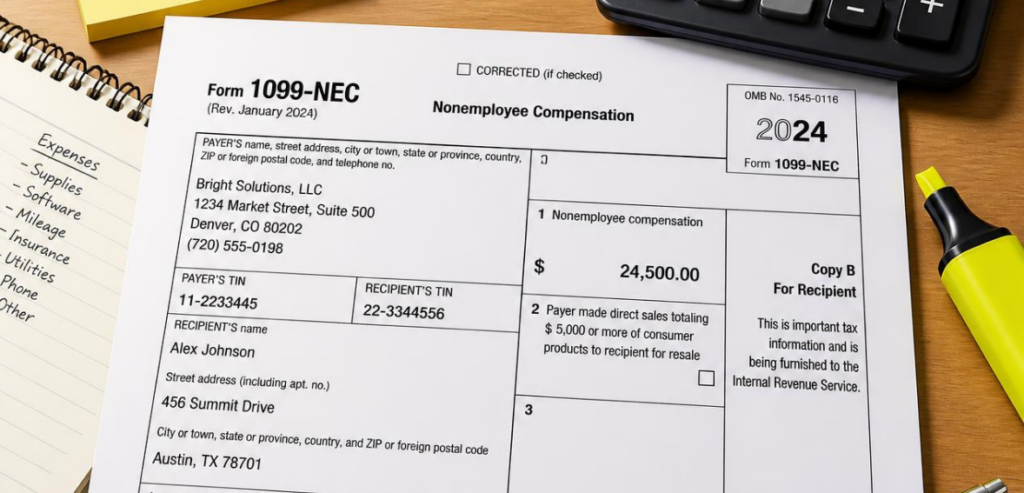
Running a yoga, Pilates, dance, or fitness studio means juggling more than class schedules. You also have to keep your tax paperwork clean. And nothing trips up studio owners faster than Form 1099-NEC.
Here’s the situation. Contract an instructor or guest teacher and your studio has a reporting obligation to the IRS. Fail to meet that obligation, and you can expect penalties, audits, and disgruntled instructors. This guide explains the 1099-NEC reporting requirements for guest instructors and studio teachers, and does so without the jargon.
What Is Form 1099-NEC and Why It Matters for Studios
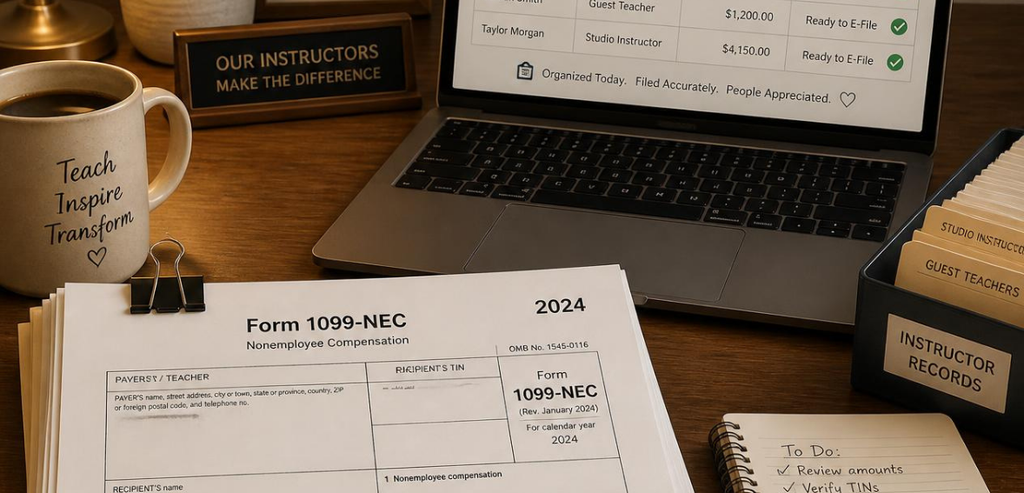
Form 1099-NEC reports nonemployee compensation. In short, it tells the IRS how much you paid an independent contractor during the year. “NEC” stands for Non-Employee Compensation.
Before 2020, this income was reported with other income on Form 1099-MISC. The IRS separated this income to help track contractor payments. Now, hiring a 1099 fitness instructor for a weekend workshop means that payment should be reported on Form 1099-NEC.
Why is this a big deal for studios? The fitness and wellness industry relies on flexible work. You bring in guest instructors to teach pop-up classes. You hire guest speakers to teach specialist sessions for instructor training. You pay extra instructors to cover for your staff who are out. All of these payments can trigger a reporting obligation. The IRS is drawing a closer line on worker classification in this industry.
Good records protect you. They prove what you paid, who you paid, and why. If the IRS ever asks, you want answers ready.
Studio Instructor or Guest Teacher: Who Actually Gets a 1099-NEC?
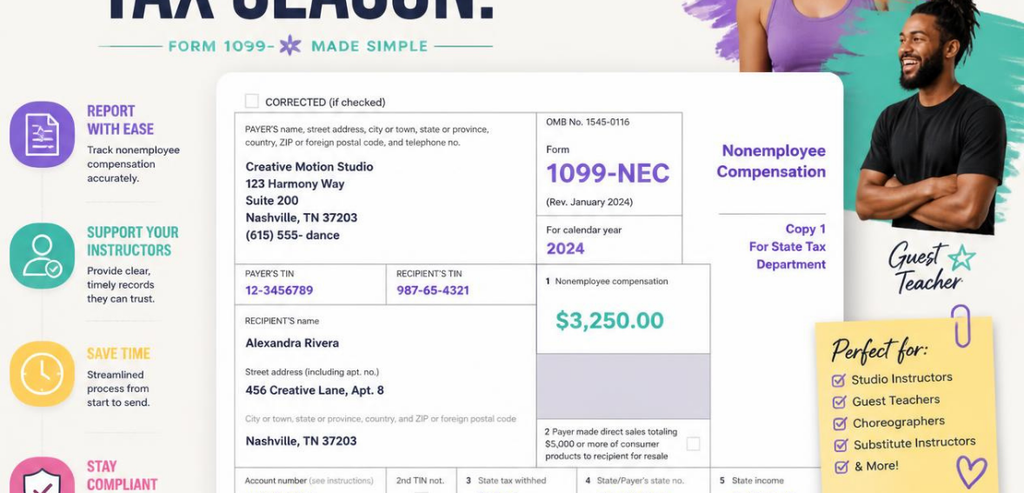
Not every instructor receives a 1099-NEC, and this is where studio owners typically go wrong. Forms are issued only to independent contractors, so the first focus is on proper classification.
A W-2 employee has taxes deducted on every paycheck. As the employer, you take care of the employee’s Social Security and Medicare tax as well as unemployment tax. A 1099 contractor handles their own taxes, and the employer only has to report the payment.
If you need another way of determining independent contractor status as opposed to employee status, one useful method is from the fitness industry. Core instructors you employ to conduct regularly scheduled classes, and who represent and endorse your studio, will most likely be classified as employees. A guest instructor contracted for a one-time, scheduled retreat, who sets their own teaching methods and works for multiple other studios, will most likely be classified as a contractor.
The Worker Classification Question
The IRS uses a three-part test to determine whether an instructor qualifies as an independent contractor or employee. The first part examines behavioral control. If you decide how, when, or in what way the instructor performs their job, it indicates the instructor is an employee. The second part examines financial control. If the instructor has another business, advertises that business, and instructs at other studios, it indicates the instructor is a contractor. The last part examines the relationship. It considers the existence of a written contract and whether the work is ongoing or project work. Employment tends to be permanent, with the work serving as a primary job function within the organization.
There is financial liability in misclassifying an instructor. Lawsuits are possible, along with financial penalties due to the IRS issuing back taxes for erroneously classifying a fitness instructor as a 1099 contractor. Many states, such as California under AB-5, apply a stricter standard that presumes most fitness instructors are employees. Comply with state regulations in addition to federal regulations. For federal regulations, see the IRS standard for independent contractors and employees.
Consult a tax professional if you are uncertain. The cost of tax advice is substantially less than the cost of an audit due to misclassification.
The 1099-NEC Filing Threshold for Fitness Studios
The dollar threshold decides when you must file. And this number just changed, so pay attention.
For tax year 2025, the threshold remains at $600 for filing the 1099-NEC. A 1099-NEC will need to be filed if a guest teacher or a contracted instructor is paid $600 or more during the calendar year (2025). This will be reported in 2026.
For payments made in 2026, a 1099-NEC will be required for payments of $2,000 or more. This change comes from the One Big Beautiful Bill Act, signed in July 2025, and takes effect for 2026. The due date for the 1099-NEC will be in early 2027. Starting in 2027, the threshold will be subject to inflation.
For tax year 2025, the threshold will count the cumulative payments to an individual for the year. In this instance, if a guest teacher was paid to conduct three different workshops at $200 each, a 1099-NEC would need to be filed since the total payment for the year was $600. It would be advisable to track all payments made to guest teachers during the year.
Records Every Studio Should Keep for 1099-NEC Instructors
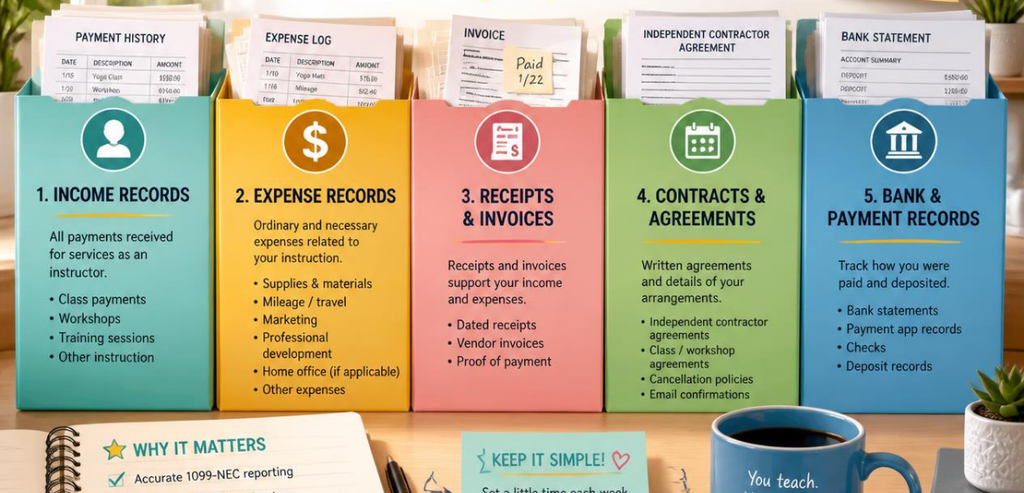
Solid records are the backbone of 1099 compliance. They make filing season smooth instead of stressful. Here are the core documents worth keeping for each contractor you work with:
- The W-9 form, collected before the first payment, holding the instructor’s legal name, address, and taxpayer identification number.
- Payment logs that show every dollar paid, the date, and the service provided.
- Signed contracts that spell out the contractor relationship, scope of work, and payment terms.
- Invoices submitted by the instructor, which reinforce their status as an independent business.
- Copies of filed 1099-NEC forms for your own archive.
That’s the one list in this guide. Everything else stays in plain paragraphs, because tax records are easier to trust when they read like a story, not a checklist.
The W-9 Comes First
Think of the W-9 as your foundation. You need this form before paying any contractor because it provides the filing information you need. You need to have it prior to making the first payment to the contractor, and you should do this for all contractors, even if you’re sure the contractor will not make it to the payment threshold.
So, why is it so crucial? If the TIN is either incomplete or missing and you do not have a W-9 form, you would be required to do backup withholding, which means that you would need to pay 24% of the payment to the IRS, and that’s an added burden you want to avoid. Collect the form, and you can avoid this issue entirely.
Payment Logs and Contracts
Track payments as they happen, not in a January scramble. A simple spreadsheet works. Log the date, the amount, the instructor, and the class or event. When filing season arrives, you’ll have your totals ready.
Contracts matter too. A written agreement that describes an independent relationship supports your classification decision. If an auditor ever questions whether a guest teacher was really a contractor, that contract becomes your evidence. Keep these records for at least four years, since the IRS can look back that far on employment matters.
Filing Deadlines and How to Submit Form 1099-NEC
The first major deadline for the 1099-NEC form is January 31. This is the date by which you must provide a copy to the contractor and submit it to the IRS. Both copies must be supplied by January 31. When January 31 falls on a weekend, the deadline moves to the next business day.
For tax year 2025, the 1099-NEC form will be due the first week of February 2026 because January 31 is a Saturday. Be aware of this deadline.
E-filing has a well-known rule that requires you to file electronically if you file 10 or more information returns in a year, and combined with the W-2s that you also have to submit, many studios end up surpassing that limit before they even realize it.
IRS IRIS
The IRS runs a free electronic filing system called IRIS, short for Information Returns Intake System. It lets businesses file 1099 forms directly with the IRS at no cost. For a small studio filing a handful of forms, IRIS can be a simple, no-fee option. You do need to enroll ahead of time, so set it up before the deadline crunch.
Third-Party Filing Software
Most studio owners prefer using specialized software for handling business taxes. They gather W-9s, track payments, verify TINs, and submit tax documents to the IRS and state agencies. Tax1099 and Boom Tax provide these services. Since they charge a fee, think about the trade-off you are willing to make regarding the burden of tax filing versus the cost of using their services.
Penalties for Missing or Incorrect 1099-NEC Filings
The IRS enforces strict deadlines for 1099-NEC filings, and penalties increase the longer you wait to submit the form. You can even be fined for not filing a required form at all.
Ignore a required filing altogether, and the penalties can run into thousands of dollars. Repeated missed filings also draw closer scrutiny, so the IRS may take a harder look at how you’re classifying your workers.
Your best choice is to file accurate and timely submissions of all required forms to avoid fines. Late submissions will cost way more than the small cost of submitting forms on time.
Conclusion
It’s simple for your studio to prepare and file Form 1099-NEC for studio instructors and guest teachers. Key components are addressing your workers’ classification, obtaining a Form W-9 from your workers prior to your studio issuing its first payment to them, and paying your workers in full and keeping track of all payments throughout the year. 1099-NEC amounts must be issued to your workers if your studio paid them $600 in 2025 or $2,000 in 2026 or thereafter. Your studio’s 1099-NEC forms are filed by January 31 of the year following the payment.
Being consistent and doing this throughout the year makes prep time for tax filings short and stress-free. Your instructors and guest teachers receive their 1099-NEC. The IRS receives their documents. Your studio does not receive an IRS audit. Your questions and tax prep issues are quickly resolved with the help of a tax professional. Your studio’s tax prep is completed in full, which leads to no unexpected payments.
Frequently Asked Questions
Do I need to file a 1099-NEC for a guest teacher I paid only once?
Yes, if the total you paid that teacher during the year hits the threshold. For 2025, that’s $600 or more, even from a single event. For 2026 and later, the threshold rises to $2,000. Track the yearly total per person, not per event.
What’s the difference between a 1099-NEC and a W-2 for my instructors?
A W-2 goes to employees, with taxes withheld from their pay. A 1099-NEC goes to independent contractors, who pay their own taxes. Your core instructors who teach the regular schedule usually count as employees. Guest teachers with independent businesses usually count as contractors.
What happens if I don’t have a W-9 from a contract instructor?
Without a valid W-9, you may be required to withhold 24% of their payments as backup withholding. You also risk filing an inaccurate form. Always collect the W-9 before the first payment to avoid both problems.
When is the 1099-NEC deadline for the 2025 tax year?
Both the recipient copy and the IRS copy are due January 31. Because that date is a Saturday in 2026, the deadline shifts to the next business day in early February 2026. If you file 10 or more information returns in total, you must file electronically.