

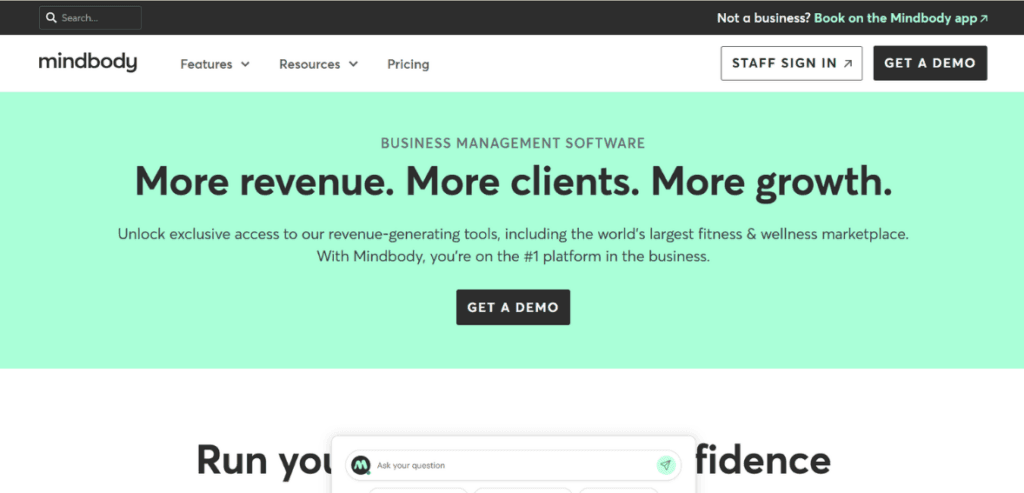
Mindbody used to be seen as the only option for boutique fitness studios. For years, many owners’ first platform selection was Mindbody. However, in 2026, that is no longer true. The market has become far more competitive, with many better options. Additionally, owners want software that is more user-friendly, with clear pricing, and that fits better with the everyday operations of boutique businesses.
Over the years, Mindbody has added so many features that it has become overly complex, hindering businesses’ operational efficiency. This is why more owners are seeking Mindbody alternatives that better fit their companies.
This guide is focused on 2026 and the available Mindbody alternatives for boutique fitness studios. It is specifically designed for boutique fitness studios and class-based businesses, such as yoga, Pilates, barre, cycling, and strength studios. It is designed to help owners find the best fit, focusing on a Mindbody competitor based on usability, flexibility, pricing, and the member experience.
Why Boutique Studios Are Looking Beyond Mindbody
The primary concern of boutiques seeking alternatives to Mindbody is the perceived financial loss associated with overly complicated systems. Instead of multiple options, stakeholders prefer to dial in to select a few primary functions. Having to spend time clicking through multiple functions, rather than simply clicking through a few add-on modules, to unlock value is viewed as a negative value add.
Pricing is also part of the discussion. Hidden costs, such as payment processing, branded apps, marketing tools, and add-ons, often raise the studio management software-as-a-service price above what the firm presents as inclusive. Baseline studio management systems proposed pricing far below the competition’s metrics.
Additionally, operational issues impact boutique fitness studios. Boutique fitness studios have now evolved to also incorporate hybrid models, recurring memberships, automated billing, retention campaigns, and multiple revenue streams. Sophisticated studios have raised their operational expectations as software has evolved into the operating system for their business.
For some studios, Mindbody remains a useful tool, as it is a ubiquitous name that works well for any business looking to build a larger ecosystem. However, boutique studio owners want alternatives to Mindbody because they seek improved workflow systems, clear, straightforward pricing, enhanced service, and more relevant tech for their business models, rather than Mindbody’s legacy systems.
What Makes a Strong Mindbody Alternative
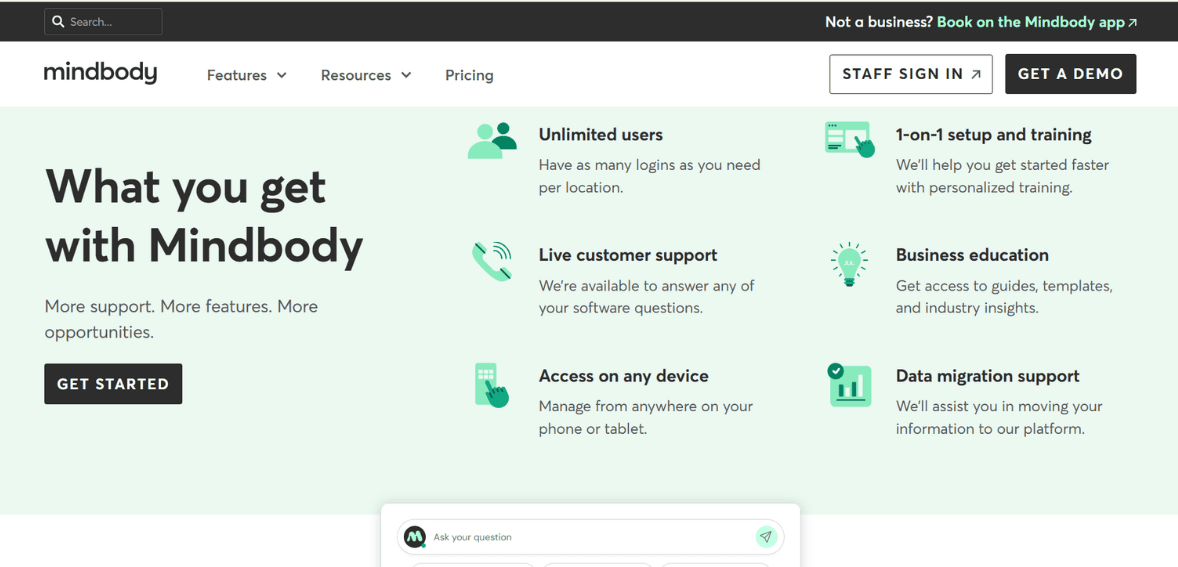
Image source
A strong replacement should first make daily work easier. Sounds obvious, but it gets overlooked. If front-desk staff, instructors, and owners struggle to complete tasks, the software becomes a hidden cost. Ease of use matters as much as features.
The best studio management software comparison should also go beyond advertised features. Owners need to review the contract terms, migration, payment processing, reporting, and how the software manages memberships, packages, waitlists, and recurring billing. In 2026, feature overlap between platforms is much greater than it used to be. Most serious tools can manage scheduling and payment. The difference often comes down to specialization, workflow, support, and the total cost of ownership.
For boutique businesses, client experience is another major factor. The booking journey needs to feel smooth. Class discovery should be fast. Purchasing memberships should be simple. Automated reminders should reduce no-shows without adding noise. A clean, simple, and intuitive client interface will improve conversion and retention.
Mindbody Alternatives and Competitors for Boutique Fitness Studios
There are several standout platforms this year, but not all of them solve the same problems. Some are better for solo or small studios, while others are better for growing multi-instructor brands. A few are built for broad wellness businesses, and others are more focused on fitness.
Cloud Studio Manager
Cloud Studio Manager has positioned itself as a good candidate to replace Mindbody for boutique fitness studios. What should be most compelling for studio owners is the simplicity. Studio owners typically don’t want to spend time on admin. They want to be present for their students, their classes, and their community.
Studio operators, particularly those burdened by the software that provides complexity over simplification, are going to be very interested in that. For those studios that want a focus on daily operational usability, Cloud Studio Manager is easily the best Mindbody alternative. It prioritizes reducing operational busywork and improving operational flow for studios.
Many boutique fitness software programs focus on the owner and coach’s operational time. The value in that operational time focus is clear in Cloud Studio Manager. With Cloud Studio Manager, boutique fitness studios have an alternative that helps run their business instead of forcing them to manage it, freeing coaches to focus on teaching and growing the business. For boutique studio brands focused on operational efficiency, community, and long-term business growth, Cloud Studio Manager should be a key point of reference in the studio management software landscape.
It is also free: $0 a month, with no per-user charge and the whole platform included from the first login.
Momence
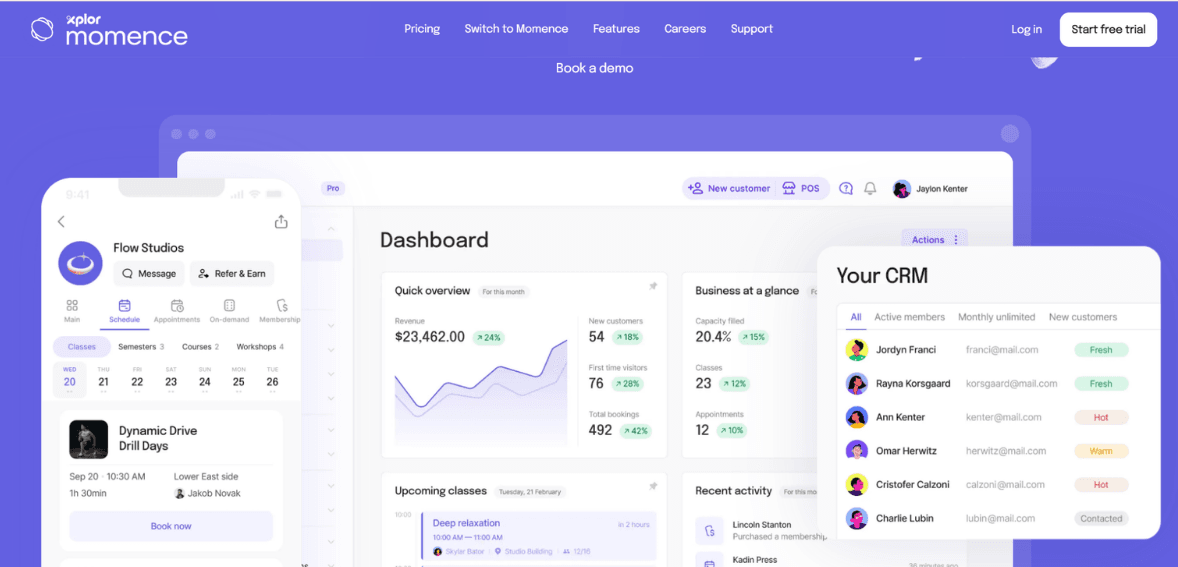
Image source
Momence is frequently mentioned as an alternative to Mindbody for boutique fitness brands. It targets studios that need a more modern design, an effective booking flow, and built-in marketing features. Momence is frequently marketed as an ideal solution for small to mid-sized fitness and wellness companies, especially those focused on design and customer care.
Momence’s biggest advantage is its customer interface. It more than adequately serves studios that prioritize online booking, visual branding, and an intuitive checkout. Momence is often perceived as more advanced than the legacy competitors. Additionally, Momence tends to attract owners who are averse to using multiple disparate marketing and communication apps.
This is a trade-off for cost. In a small number of 2026 comparisons, real monthly costs became much more variable due to revenue share, processing, and contract terms. This does not inherently make the apps a poor choice, but operators should focus on the total contract cost rather than just the initial price.
Glofox
Glofox remains the recognizable Mindbody competitor for fitness studios seeking a class-based, branded member experience. It is often selected by studios seeking a more fitness-centered approach, especially when mobile app branding or a more refined digital front door is a priority.
For boutique operators, Glofox demonstrates an understanding of the logic of memberships, class packs, and schedule-driven businesses. It tends to be viewed more favorably as a fit for fitness studios than for other verticals with service-broad businesses, which provides a sense of relevance for studios built around recurring attendance and community.
The most relevant caution is that some market reviews continue to warn about add-ons and rigidity of contracts, as these are things to analyze in detail. A platform can seem to be a great operational fit, however, in a scenario where a studio is aiming to remain agile, the terms of the contract are as important as the features.
WellnessLiving
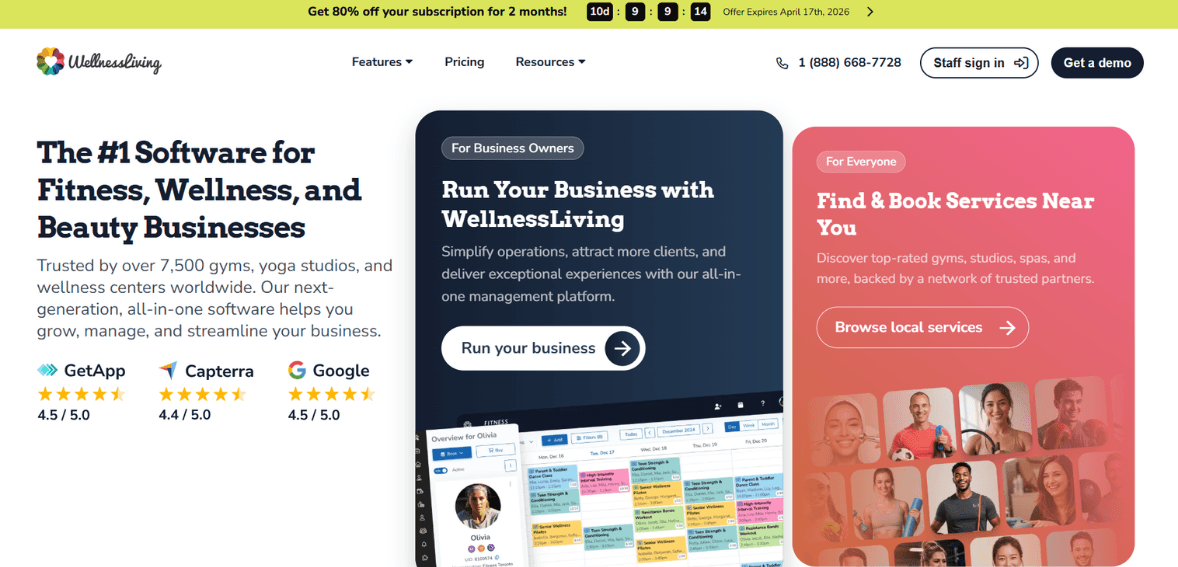
Image source
WellnessLiving is often cited when studios are looking for a broad, all-in-one platform without having to go to Mindbody. It typically suits businesses that want depth in scheduling, payments, client management, and marketing. This is often appealing for a studio with several moving parts.
Its strength is in depth. A boutique fitness studio growing and seeking a single system to manage both operations and client communications may find it sufficient to minimize the number of tools used. It also usually comes up in conversations around wellness and studio businesses that require flexibility as they grow.
That said, market comparisons suggest that pricing prediction becomes more challenging as additional services are layered in. Studio owners evaluating Mindbody alternatives should assess not only the demo but also the actual cost implications for their studio size and revenue model.
Vagaro
Vagaro is one of the more prominent, lower-cost options in the broader appointment and service software market and is frequently referenced as an affordable boutique fitness software alternative. That is relevant for studios seeking to minimize fixed expenses.
Its appeal is in its accessibility. A studio that requires scheduling, payment, and basic business management services at a reasonably low entry price is likely to find Vagaro a more attractive alternative to more expensive systems. Some comparisons between 2025 and 2026 also suggest it as a low-cost option for yoga, fitness, and pilates studios.
The question isn’t whether Vagaro will work. The simple answer is yes. Is it sufficiently premium for the boutique studio experience? For some operators, the answer is yes. For many others, particularly those with high-touch premium models, the member journey is likely to feel less tailored compared to other, more specialized solutions.
Some businesses choose Acuity Scheduling because it is simpler than other options, but the seemingly simpler interface is particularly advantageous for single-operator, appointment-heavy, and less operationally intensive studio businesses. In competitive market positioning, this platform is often cited as one of the best options for solo practitioners, thanks to its affordability and ease of use.
For fully developed boutique studios that require memberships, recurring classes, multiple instructors, and complex retention workflows, Acuity may prove overly simplistic. However, for smaller businesses, it is counterintuitive to choose an overly sophisticated option and, for these businesses, it can be a sensible alternative. This highlights the point that a Mindbody competitor does not always have to be the one with the most features. In this case, an alternative that offers the most simplicity may be the best option.
Walla, PushPress, and Other Specialized Platforms
The broader 2026 market also shows a clear trend toward specialization. Some platforms are chosen not because they aim to serve everyone, but because they are better suited to one type of studio. Industry roundups highlight platforms such as Walla for boutique fitness use cases and PushPress for more specific training-focused models.
This matters because boutique operators often perform better with software that reflects how their businesses actually run. A Pilates studio, HIIT concept, yoga school, or CrossFit gym does not always need the same structure. The more specific the model, the more useful a specialized platform can become.
Selecting the Right Platform for your Studio

Selecting software is not just about extracting features. It is a decision about designing a business model. The appropriate platform must facilitate how your studio sells, books, retains, and communicates, and align with your level of growth.
A developing studio may require the triad of affordability, speed, and simplicity. An established studio may require advanced reporting, more robust automation, and more seamless support for memberships and staff management. A multi-site brand may prioritize scale and uniformity. This highlights the point that any serious comparison for studio management software must begin with the business fit first, and popularity second.
One helpful way of approaching the decision is through friction. Identify where your current system is creating drag. If it is in the pricing, prioritize transparency. If it is at the front desk, prioritize usability. If it is in retention and communication, prioritize automation and marketing. If it is in the brand experience, prioritize the client-facing journey.
Before switching, studios should also examine what support is available for migration. The experience of data transfer, which can be seamless or burdensome, depends a lot on the provider. A platform that supports moving clients, memberships, packages, and schedules is often more valuable than one that offers a slightly more comprehensive feature set.
The most significant trend is studio owners being selective, not just the existence of more Mindbody alternatives. They are not swayed by expansive feature lists, and they prioritize fit, clarity, and execution.
The 2026 software market reflects that change. Industry-wide reviews and comparisons consistently highlight the importance of clear, transparent pricing, ease of use, flexible contracts, and a strong practical business fit. This indicates that studio operators are progressing into more mature buying mindsets.
The question is no longer, “What is the biggest platform?” But rather, “What helps this specific studio run better?”
Conclusion
The best Mindbody alternatives for boutique fitness studios in 2026 will win in different ways. Some will win by offering a more seamless booking and branding experience. Others will win by offering a more competitive price. Some will win by offering greater flexibility, a better operational fit for modern fitness businesses, and stronger niche specialization.
The best news for studio owners is that now they actually have a real choice. A studio that feels trapped by high prices, poor workflows, and lack of support no longer needs to settle. The best Mindbody competitor will be the one that reduces admin tasks, enhances the member experience, and supports your growth without adding complexity.
For boutique studios, that is the real standard. It does not have the longest feature list or the biggest name. It has software that helps the business run better.
Frequently Asked Questions
What are the top Mindbody alternatives for boutique fitness studios?
The main options are Cloud Studio Manager, Momence, Glofox, WellnessLiving, Vagaro, and a number of niche fitness studio-specific platforms. The best choice will depend on your studio size, budget, brand experience, and operational requirements.
Why are studio owners moving away from Mindbody?
Most owners considering Mindbody alternatives want simpler workflows, more transparent pricing, better customer support, and software that aligns better with boutique studio needs. Many also want a more up-to-date customer journey and more transparency on costs.
Are there Mindbody competitors that are more affordable?
Yes. Vagaro and simpler platforms like Acuity Scheduling are lower-cost options that some businesses consider. The con is that lower-cost options are unlikely to provide the same degree of specialization or premium member experience as more sophisticated boutique fitness software alternatives.
How can I evaluate the alternatives to boutique fitness software?
Evaluate the degree of business fit first. Consider the actual monthly cost, contract length, client booking experience, reporting and automation, migration support, and how well the platform manages memberships and recurring billing. A studio management software comparison should prioritize daily usability over feature-centric focus.