

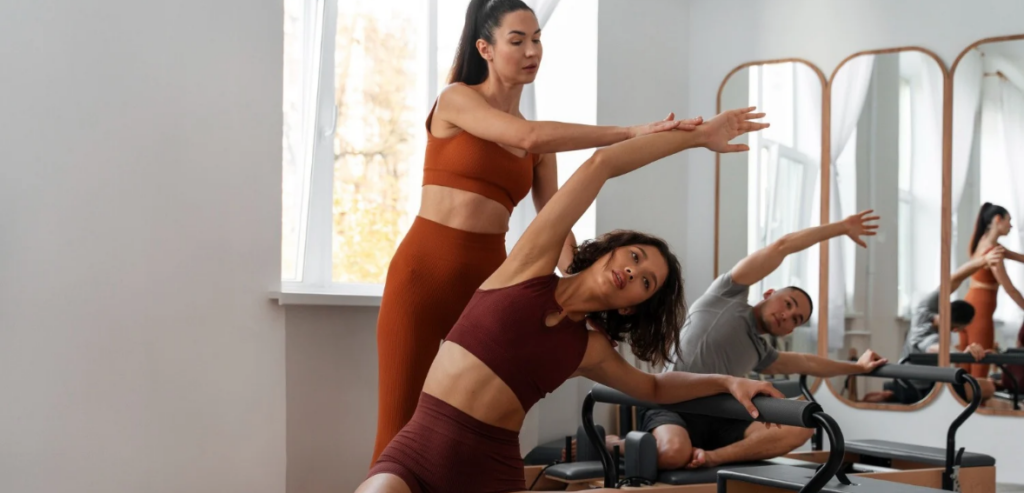
A reformer drop-in runs a median of $45 in New York and $36.50 in Los Angeles, according to Junocal’s survey of 24 US studio menus observed in August 2026. The gap is not demand, it is rent and machine count. Pilates class pricing is driven by equipment cost per class spot more than by anything else, which is why mat and reformer behave like different businesses. This is for owners setting or revisiting a price list.
Why Reformer Pricing Is Different
Three structural factors, and together they explain nearly the whole premium over mat.
Capital cost per spot. Smart Health Clubs’ April 2026 guide puts reformers at $2,000 to $5,000 or more each, with six to ten machines typical and studio startup at $80,000 to $200,000. Every class spot in a reformer room carries a machine that has to be paid for, maintained and eventually replaced. A mat room carries a mat.
Class caps. A reformer class is capped by machine count, usually six to twelve. A mat class is capped by floor space, which is considerably more forgiving. The same instructor hour therefore has to be recovered from fewer people, which is the arithmetic behind the Airtasker spread of $15 to $35 for mat against $25 to $60 for reformer.
Instructor cost. Reformer teaching requires apparatus certification, and instructors with it command more and are harder to replace. Your schedule depth is limited by who can teach, not by who is available.
The practical consequence for pricing is that reformer rates have to be set from cost per spot rather than from what the mat class across the road charges. Take your fixed monthly costs plus instructor pay for the hour, divide by the realistic average attendance rather than the machine count, and that is your floor. A twelve-machine room averaging seven is a seven-spot business.
The reformer pilates class price you land on should also reflect what the machine time is worth to the client. People who come three times a week for apparatus work are buying access to equipment they cannot replicate at home, and they know it.
Drop-In, Class Packs, Unlimited: Which Model Fits
Three pilates pricing models, and most studios run all three with different jobs.
Drop-in exists for visitors, trial-adjacent clients and people who refuse to commit. Price it high enough that it is the worst value per class on your menu, because its function is to make the pack look sensible. Junocal’s median reformer drop-in of $40 against a 10-pack effective rate of $35.70 shows that gap is often too small to do that work.
Class packs suit clients attending one to two times a week and people whose schedules vary. They produce cash up front and a commitment that is not a subscription. The design questions are the discount ladder across pack sizes and the expiry, which has to exist or packs become indefinite liabilities. Mat Pilates ATX, cited in Junocal’s October 2026 mat menu check, applies a six-month expiry on its 20-class pack.
Unlimited or high-frequency memberships suit your most engaged clients and produce the predictable revenue that makes a studio plannable. Junocal’s surveyed median was $294.50 with a range of $199 to $400, and an eight-classes-per-month tier at a median of $220, which is the structure most reformer studios land on because truly unlimited access to capped machines creates booking conflicts.
The practical design is a ladder where each step up lowers the per-class price and raises the commitment: drop-in, small pack, large pack, monthly tier, unlimited. Make the step a client is most likely to take the one with the clearest value, and price pilates class packages so that moving up is obviously worth it. The mechanics of that ladder are covered in finding your optimal class pack pricing and package and pass architecture.
For capped-equipment studios, pair unlimited pilates membership pricing with booking rules: a limit on how many classes can be held at once, a cancellation window, and a late-cancel fee. Without those, a small number of members hold spots they do not use and your popular times look full while running at two-thirds.
Intro Offers and Founding Rates
The intro offer is an acquisition cost, not a revenue line, and its job is to get someone to four or five sessions where the habit forms.
Published intro pricing from Airtasker’s October 2026 guide: mat-only packs of three to four classes at $60 to $90, a mat 14-day unlimited trial at about $60, boutique reformer intro packs of two to three classes at $40 to $90, and boutique reformer unlimited trials of one to three weeks at $89 to $125. The same guide notes a national franchise offering a free 30-minute intro class or an unlimited first month at $99.
Two design rules. Length over discount: a two-week unlimited trial builds more habit than three cheap classes spread across a month. And a process behind it: a booked first session, a greeting by name, a check-in after the second class, and a conversion conversation before it expires. The intro offer playbook covers that sequence.
Founding rates, offered when a studio opens, are a different instrument. They buy early cash flow and a core of committed members in exchange for a permanently lower price. Use them deliberately: cap the number, cap the duration if you can, and model what your revenue looks like in year three when a quarter of your members are still paying the opening rate. Founding members are also your most vocal advocates, which is the argument for honoring the rate rather than quietly retiring it.
Private and Duet Pricing
Privates carry the highest revenue per hour and the lowest capacity, which makes them a margin product rather than a volume one.
Junocal’s survey of 13 studios in August 2026 put private sessions at a median of $125 with a range of $100 to $175. Airtasker’s October 2026 guide puts private reformer sessions at $65 to $175, reaching about $200 at premium New York and Los Angeles boutiques, private mat at $40 to $100, and boutique instructor rates at $110 to $200 or more per hour.
Duets and small-group sessions sit between. Airtasker puts duet and semi-private at $40 to $100 per person, and Junocal cites one Austin studio at $55 per person for a duet or trio. Two clients at $55 each produce $110 for the same hour that a $125 private produces, with better retention because the pair keeps each other attending. The two-to-four client model is covered in semi-private training pricing and programming.
Price privates to protect your group schedule. If a private hour earns less than a full group class in the same room at the same time, you are subsidizing one client with studio capacity. Run the comparison before setting the rate, and consider restricting privates to off-peak hours where that arithmetic is tight.
Raising Pilates Prices Without Losing Members
Raise annually, modestly, with notice. Studios that hold prices for three years then raise fifteen percent lose members who would have absorbed four percent a year without comment.
What to do:
- Recalculate cost per spot every year, since rent, instructor pay and machine maintenance all move
- Give 60 days notice, in one direct email naming the new rates and the effective date
- Pair it with something visible: new machines, a reupholstered set, more schedule depth, a better booking experience
- Protect existing members for one cycle rather than grandfathering forever, which otherwise leaves you running four price lists
- Raise the drop-in rate first if you are nervous, since it affects the fewest committed clients and widens the gap that makes packs attractive
- Expect a small number of cancellations and treat zero cancellations as evidence the old price was too low
Communicate it as a studio decision rather than an apology. Clients who train three times a week in a room with equipment they value are considerably less price-sensitive than owners assume, and the ones who leave over a modest increase were usually leaving anyway.
For the wider picture of what pricing produces at the owner level, see how much yoga and pilates studio owners make. Cloud Studio Manager is free studio management software for scheduling, packs and membership billing, with payments processed through Host Merchant Services. See the features page and pilates studio software, and you can model a new price ladder in the free studio management software before announcing it.
Frequently Asked Questions | Pilates Class Pricing
How much does a pilates class cost?
Airtasker’s cost guide, updated October 15, 2026, puts group mat classes at $15 to $35 and group reformer classes at $25 to $60 per session. Junocal’s August 2026 survey of 24 US studio menus found a median reformer drop-in of $40, ranging $25 to $50. Private sessions run $65 to $175, with a surveyed median of $125.
Why are reformer pilates classes more expensive?
Equipment and capacity. Smart Health Clubs’ April 2026 guide puts reformers at $2,000 to $5,000 or more each, with six to ten per studio, so every class spot carries a machine to pay for and maintain. Reformer classes also cap at machine count rather than floor space, so the instructor hour is recovered from fewer clients.
What is a good price for a pilates class pack?
Price it so the per-class rate is clearly better than drop-in but above your cost per spot. Junocal’s August 2026 survey found a median reformer 10-pack of $357, which is $35.70 per class against a $40 median drop-in. Airtasker puts 5-packs at $60 to $270 and 20-packs at $320 to $850. Always set an expiry.
Should a pilates studio offer unlimited memberships?
Yes for engaged clients, with booking rules attached. Junocal’s August 2026 figures put unlimited or high-frequency memberships at a median of $294.50, ranging $199 to $400, with an eight-per-month tier at a median of $220. In capped-equipment studios, limit concurrent bookings and enforce a cancellation window, or a few members will hold spots they never use.
How often should a pilates studio raise prices?
Once a year, by a modest amount, announced at least 60 days ahead. Recalculate your cost per spot annually, since rent, instructor pay and maintenance move. Pair the increase with something visible such as new or reupholstered equipment, hold existing members at the old rate for one cycle, and expect a few cancellations as normal.
This is general information, not legal or tax advice.