

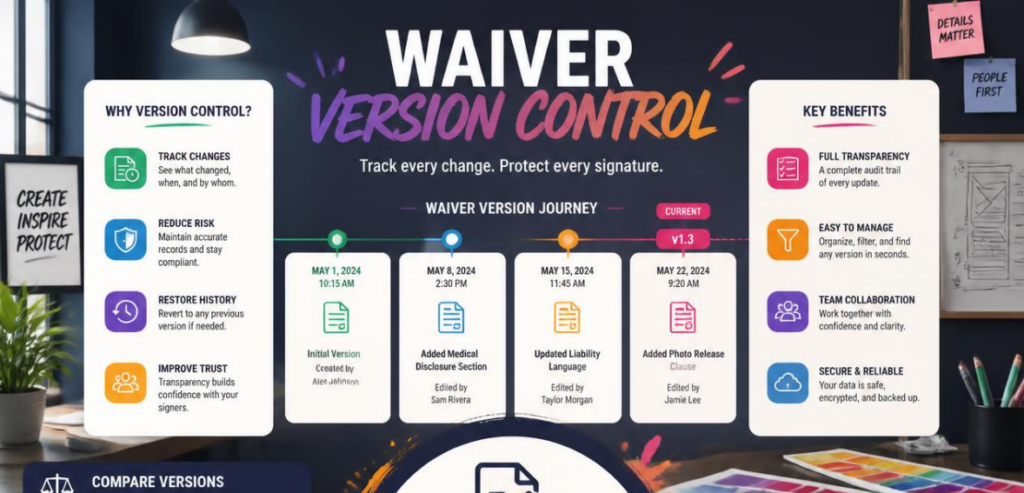
A client slips during your brand-new HIIT class. A few weeks later, a claim lands on your desk. You pull her signed waiver to prove she accepted the risk. But that form is three years old. It covered gentle yoga. It never mentioned high-intensity training, plyometric jumps, or heavy equipment.
Now, you have a gap in your legal shield.
This is the silent risk most studio owners are blindsided by. Waivers have an expiration date. Programs evolve. Policies change. One outdated signature can collapse your entire legal defense.
Version control for fitness waivers eliminates this risk. It stores every signature in association with the relevant rules and risks a client agreed to. This document will inform you how to set up a waiver control system that works when you most need it.
What Is Fitness Waiver Version Control?
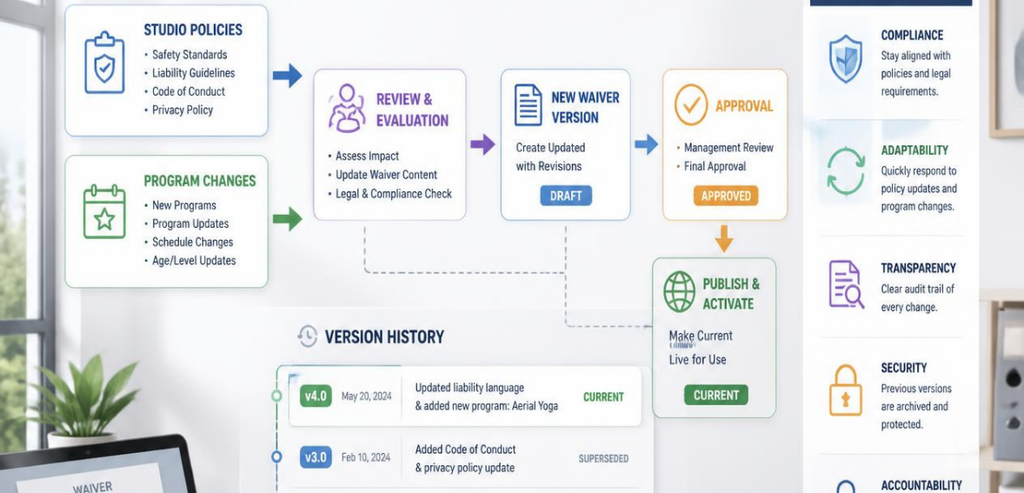
Version control involves maintaining a history of alterations made to your liability waiver. Every adjustment to your document warrants the creation of a subsequent version. A log of the adjustment is then created that captures the reason and time of the adjustment. Each client’s signature is then matched to the respective version.
Version control can be likened to operating software updates. A class waiver is the first version. A subsequent version may be created to add new class language. A version can also be created to capture changes in state law. The changes happen in the different versions, and older versions are retained.
This is especially critical since a waiver only covers the risks it describes. A court of law will reference the version of the waiver signed by the client. Waiver governance links your risk records to your actual business activities, creating a stack of forms that translates to a reliable legal defense.
Why Policy and Program Changes Trigger a New Waiver Version
Most studios treat waivers as a one-and-done task. A member signs on day one, and everyone moves on. That approach breaks down the moment your business changes.
The biggest triggers for waivers are new services. Let’s say you opened your business as a barre studio and later added aerial silks. A barre waiver will not cover an aerial silks class, as aerial work has a different set of risks. The same goes for adding boxing, spin classes, hot yoga, and reformer Pilates; each new class activity comes with different risks that you must clearly define in your waiver.
Different equipment also presents different risks. Adding kettlebells, sleds, cable machines, and recovery equipment (saunas, cold plunges) can change your risk profile when added to your studio. A waiver drafted before the additions is not sufficient.
Different policies also require a new waiver. If you changed your policy regarding how members report injuries, your cancellation policy, how you handle minors in your studio, or your photo release policy these all require a new waiver.
The last major trigger is the law. Rules on waiver enforceability change as the law changes. If a law or court ruling changes how waivers must be worded to be enforceable, then your waiver needs to be updated. The consensus in the industry is that waivers must be reviewed at least annually, and after any significant change in your services, your risks, or the law.
The Legal Backbone: ESIGN, UETA, and Enforceable Signatures
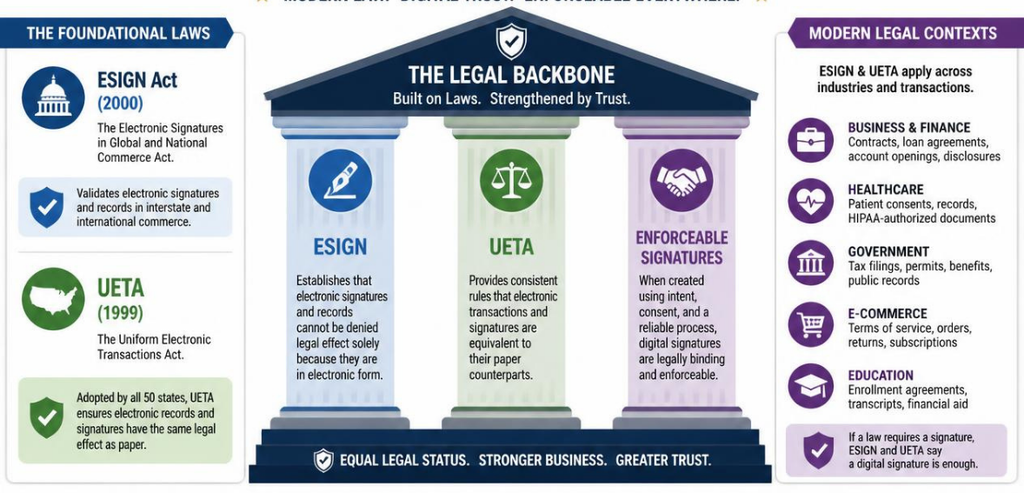
Waiver version control only works if your signatures are legally valid in the first place. In the United States, two laws make that possible.
The federal ESIGN Act, signed into law in 2000, gives electronic signatures the same legal weight as ink on paper. Alongside it, the Uniform Electronic Transactions Act (UETA) has been adopted by 49 states, with New York using its own closely related statute. Together, they let your studio collect binding waivers online.
However, four criteria must be satisfied for a digital signature to be enforceable. The signer must exhibit clear intent to sign. There must be mutual agreement to conduct electronic transactions. The signature must bind the relevant electronic record. Lastly, the signed electronic record must be stored and capable of being retrieved.
Version control is critical to satisfy the last requirement. In addition to a signature, knowing the exact language of the signed version and the date the signer executed the signature is essential to prove enforceability. Waiver governance of the highest quality creates this level of proof. In its absence, even a digital signature may be difficult to defend.
How to Build a Waiver Version Control System That Holds Up

A good system doesn’t need to be complicated. It needs to be consistent. Start with a clear numbering scheme so every version has a unique label, such as v1.0, v1.1, or a simple date-based code. Pair each version with an effective date, so you always know which document was live at any given moment.
Lastly, you need a simple record of changes. A short sentence like “v2.0 added language for new spin classes, effective March 2026” can save you time during a dispute years later. This record will hold the details related to your studio’s evolving safety practices and will serve as the central aspect of your risk record.
Establish clear triggers to re-sign. Decide when acceptance of a new iteration will be required of a client. A good policy is to establish a clear signing requirement when a new iteration is created as a result of significant changes to policies or programs, when the status of a member’s health is changed, and on a set time interval, for example, once a year. Notify the member and have them sign before their next session.
Your archive is the answer to one question: which waiver did this person sign, and what did it say? You can answer this question only if every record is securely stored and every version readily available. As such, never delete old versions of signed forms.
Tools That Make Waiver Governance Easier
You can run version control with organized folders and disciplined naming. But dedicated waiver software removes most of the friction. It timestamps signatures, links each one to a specific version, and stores everything in a searchable archive. It also lets you push an updated waiver to every member without reprinting a single page.
WaiverSign
WaiverSign is a digital waiver solution for gyms, studios, and activity businesses. It can collect electronic signatures and offers custom fields for specific data collection needs for your studio. With WaiverSign, you can adjust your form anytime there is a change in policies or state laws. Storing signed waivers in a single location streamlines the process of matching a member to their signed waiver, compared to a filing cabinet.
Zenoti
Zenoti is an extensive fitness and wellness management application with integrated solutions for waivers, scheduling, payment processing, and client files. Waivers are part of business-critical information that is maintained in an encrypted format. Sensitive client information is also maintained in an encrypted format. Zenoti supports digital waivers compliant with the ESIGN Act and UETA. A system like Zenoti allows multi-location studios to integrate waiver management with the rest of their processes, thus minimizing the number of repositories where their business risk records are stored.
How Long Should You Keep Old Waiver Versions?
Retention is where many studios get nervous, and understandably so. The safe answer is simple: keep everything, for a long time.
You must keep signed waivers for the duration of your contractual agreement with the client. After it ends, keep it for the duration of the statute of limitations for your state. Members can take a long time to file a claim, and if you have thrown out the signed waiver, you have no evidence to defend yourself.
If there is no law that makes it necessary to keep waivers for a certain amount of time, many advisors suggest you keep signed waivers for 7 years. You can consult a lawyer with respect to your state for a more precise answer. And again, this applies to old versions, not just the current one. If a client last signed v2.0 and never signed anything after, v2.0 is the document that matters. You have to keep old versions even if you don’t use them.
Common Waiver Governance Mistakes to Avoid
The most common mistake is silent overwriting. A studio edits its single waiver file, saves over the old one, and destroys the record of what earlier members agreed to. Version control exists specifically to prevent this.
Another common mistake is thinking that one signature is sufficient forever. A waiver signed by a member at a beginner yoga class does not cover that member’s participation in an advanced kettlebell program two years later. Without points of re-signing, a gap in waiver coverage continues to exist until a claim is made.
Another blunder studios make is revising the waiver and not collecting new signatures. An updated version 3.0 of the waiver sitting on your studio’s website protects no one if your members still have version 1.0. The update is only effective once a new signature is collected.
Lastly, many studio owners forget that using general or vague language in a waiver will not protect against current claims. Courts tend to favor releases that articulate in specific and plain language the activity to be released and the risks associated. Each new activity or program should be clearly articulated and described, rather than using general language.
Conclusion
Your studio is not the same business it was when you opened. Your waiver shouldn’t be either. Programs expand, equipment arrives, policies mature, and laws shift. Fitness waiver version control keeps your paperwork in step with all of it.
The payoff is real protection. When you can instantly show which version a client signed, when they signed it, and exactly what it covered, you turn a pile of forms into a genuine legal shield. That’s the essence of good waiver governance: clean risk records, matched to the real risks your members face today.
Start small. Number your versions, log your changes, set your re-signing triggers, and archive everything. Then lean on the right tools, and check in with an attorney for your state. A little discipline now saves you enormous stress later.
Frequently Asked Questions
How often should a fitness studio update its liability waiver?
Review your waiver at least once a year. Update it right away whenever you add a new program or piece of equipment, change a policy, or when your state’s laws affecting waivers change. An annual cadence plus event-based updates keeps your risk records current without over-managing the process.
Do clients need to sign a new waiver every time it changes?
For meaningful changes, yes. If you add new activities, alter key policies, or update legal language, existing members should accept the new version before their next relevant session. Minor typo fixes usually don’t require re-signing, but any change that affects what a client is agreeing to should trigger a fresh signature.
Are electronic waivers legally valid in the United States?
Yes. The federal ESIGN Act and state-level UETA give digital signatures the same legal standing as handwritten ones. To hold up, the process must show clear intent to sign, consent to sign electronically, a signature tied to the specific document, and a retained, reproducible record. Reliable version control helps satisfy that last requirement.
How long should I keep old versions of my waiver?
Keep signed waivers for at least the duration of the client relationship, then well beyond it based on your state’s statute of limitations for injury claims. In the absence of a specific rule, roughly seven years is a common benchmark, though an attorney can advise on your exact situation. Always keep retired versions, not just the current one.