


The strongest boutique studios today aren’t just beautiful spaces or motivating environments, they’re data-powered businesses. A thriving studio is built on consistent decisions made from clean, reliable numbers. While passion drives the culture, data drives the direction. And for modern studio owners who want to grow confidently, fitness studio KPIs to track daily are the anchor that keeps everything steady.
The fitness industry has changed dramatically in recent years. Clients expect more personalization, more convenience, and more value. Competition has grown from big-box gyms, emerging franchise chains, online fitness platforms, and hundreds of independent studios fighting for attention. In this environment, guessing isn’t a strategy. Instinct alone can’t tell you whether your attendance trends are healthy, whether your classes are priced correctly, whether your marketing is paying off, or whether your clients are at risk of cancelling.
This is where daily KPIs become non-negotiable. They give clarity in moments where emotion or assumptions would have misled you. They highlight what’s working, what’s weakening, and what needs intervention before small dips turn into big problems. When consistently reviewed, these KPIs reveal patterns that help you make fast, confident, profitable decisions.
A good data dashboard isn’t overwhelming. It shouldn’t feel like a spreadsheet explosion or a confusing puzzle. Instead, it should be a morning ritual, a quick 10–15-minute check that equips you with the intelligence for the day. With the proper structure, your dashboard becomes a compass, pointing you toward the specific actions that increase retention, revenue, and class performance.
Before building that habit, though, you need to understand the seven KPIs that matter most. Not 20 metrics. Not 40. Just seven. These are the numbers that determine whether your studio is growing, stagnating, or silently slipping.
The 7 Non-Negotiable KPIs for Boutique Studio Success
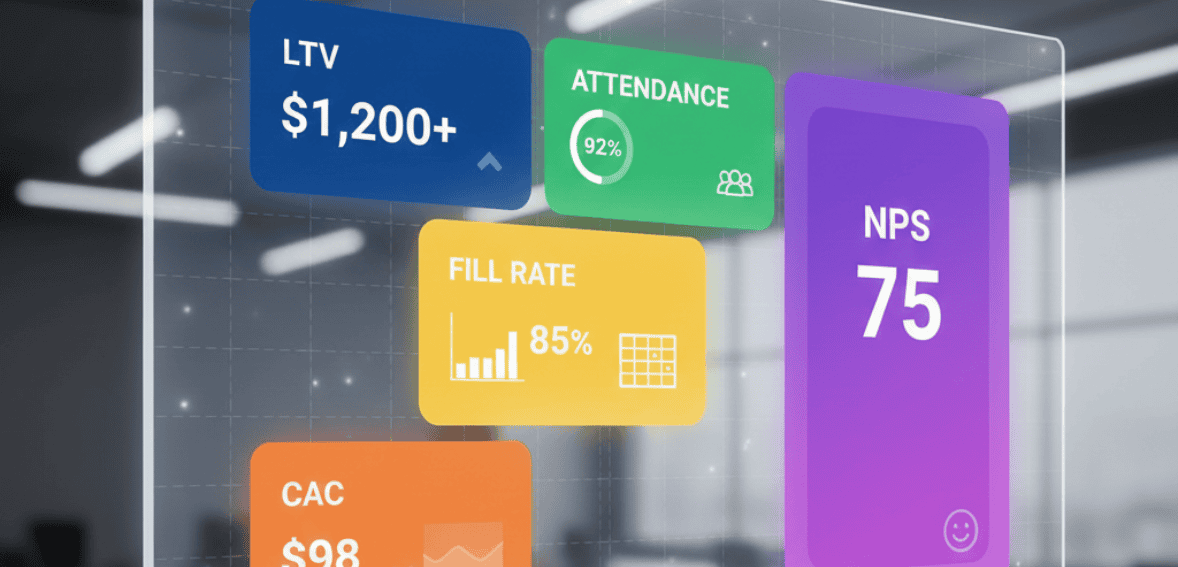
Every studio has dozens of numbers floating around in its management system attendance logs, revenue records, subscription data, marketing details, cancellation reasons. But only a handful of these numbers can accurately predict your studio’s trajectory. These seven KPIs are the heartbeat of a boutique fitness business. They tell you how strong your client relationships are, how healthy your pricing is, how efficient your marketing is, and how stable your monthly revenue feels.
Let’s break down each one in a way that feels natural, human, and actionable because a KPI is only useful if you understand what it means and how to act on it.
Member Lifetime Value (LTV)
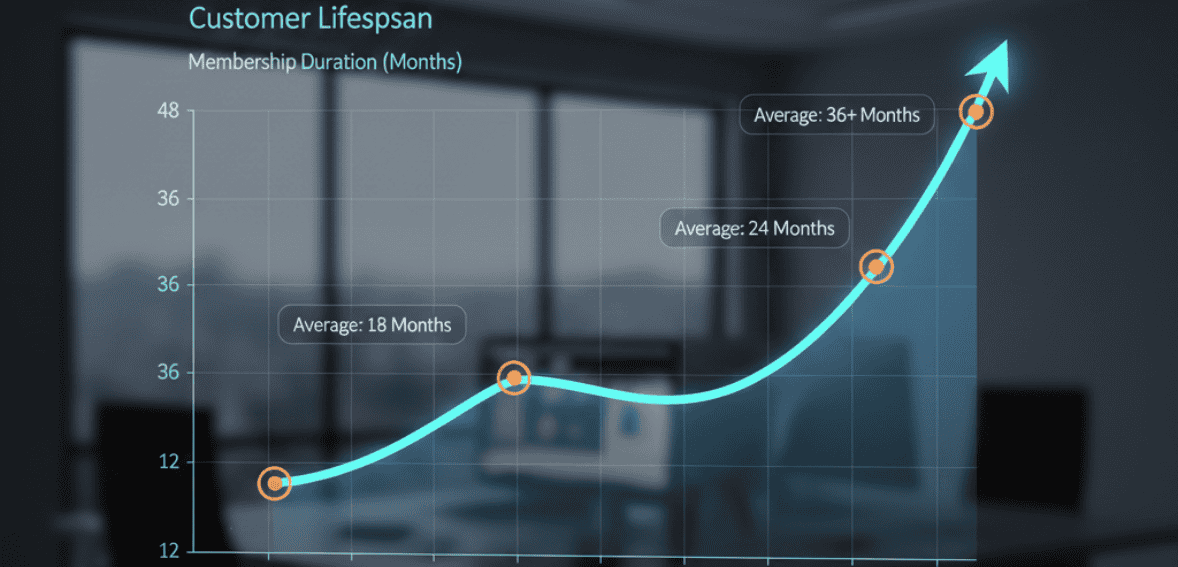
If you could only track one metric in your studio just one this would be it. Member Lifetime Value tells you how much revenue the average client brings in before they eventually leave. It isn’t just a financial number; it’s a window into your studio’s long-term health.
A high LTV means clients stay longer, spend more, attend frequently, and see value in your offerings. A low LTV usually means clients don’t progress far enough to become loyal, don’t form habits, or leave before they build an emotional connection with your brand.
Most studio owners underestimate how powerful this metric is. It influences everything from how much you can afford to spend on marketing to how you price your memberships. When you know your LTV, you know exactly how profitable your clients truly are. And when you know that, you can invest in growth without fear.
LTV also increases when your retention improves, when your customer journey strengthens, and when your coaches deliver consistent, memorable experiences. It’s a KPI that touches every corner of your business, which is why it belongs on your dashboard every morning.
Attendance Rate
Attendance is the heartbeat of engagement. A member paying for a membership but not showing up isn’t a quiet win, it’s an early warning sign. In the fitness world, low attendance is the first step toward the dreaded “silent cancellation.”
A healthy boutique studio tracks attendance like a teacher tracks class participation. When attendance dips, problems follow: lower renewal rates, more cancellations, reduced class energy, and weaker word-of-mouth growth.
Daily attendance trends reveal a lot:
- Which classes are gaining momentum
- Which instructors consistently drive full rooms
- Which times of day need rethinking
- Which clients haven’t attended in weeks
When you review attendance each morning, you learn exactly who needs outreach today, which classes require promotion, and where to redistribute schedule strength. Attendance isn’t just a number, it’s a daily checkup on the emotional connection between your members and your studio.
Revenue Per Class
Every class costs money to run your instructor’s time, your utilities, the opportunity cost of using that slot for something else. But not every class generates the same value. Revenue Per Class answers one central question: “Was this class financially worth running?”
It’s an incredibly grounding metric. Some classes appear full but generate low revenue due to discounts or pack usage. Others look half-full but bring in premium-paying members. This KPI helps you redesign your schedule, improve class distribution, optimize pricing, and ensure that each session contributes fairly to the studio’s sustainability.
Studios that look healthy from the outside sometimes discover that half their classes are financial dead weight. Meanwhile, other studios thrive because they constantly adjust their offerings based on real per-class performance not assumptions.
Looking at this number daily doesn’t mean rushing to change things overnight. It gives you awareness of where value is building and where it’s fading.
Client Acquisition Cost (CAC)
It doesn’t matter how smart your marketing looks if you don’t know how much you’re spending to bring in one paying member. CAC brings transparency to your marketing efforts. Every boosted post, every campaign, every referral incentive, every ad this number sums it all.
Boutique fitness is not a mass-market business, so you can’t afford unclear marketing math. If your CAC is lower than your Member Lifetime Value, you’re winning. If it’s higher, you’re losing money with every new client.
Tracking CAC daily helps you spot which campaigns are gaining traction and which ones need to be paused. It empowers you to spend confidently instead of anxiously. And it forces you to build marketing systems that are actually profitable, not just active.
Net Promoter Score (NPS)
NPS is a window into your members’ hearts. It reveals how many of your clients would genuinely recommend your studio to others and how many quietly feel disengaged. A high NPS means your members love the experience enough to talk about it. A low NPS implies something isn’t clicking, even if people haven’t canceled yet.
NPS also predicts referrals, retention, and long-term reputation. Your happiest members become evangelists. Your passive members drift away. Your unhappy members become vocal online. Checking your NPS regularly helps you avoid mistaking silence for satisfaction.
Class Fill Rate
This KPI tells you how efficiently you’re using your schedule. A high fill rate means your classes are structured well, instructors are strong, times are convenient, and demand aligns with supply. A low fill rate suggests misalignment either your schedule needs adjusting, your class capacity is too high, or your offerings need rotation.
It’s not just about full rooms, it’s about optimizing each time slot so the studio feels alive, energetic, and profitable.
Cancellation Lead Indicators
Cancellations rarely come out of nowhere. Clients give subtle signs before they leave attendance drops, class check-ins slow down, membership freezes increase, or engagement becomes inconsistent.
These signals are the “leading indicators” of churn. When tracked daily, they allow you to intervene with personalized outreach, win clients back, and prevent revenue loss. Ignoring these indicators is like neglecting a smoke alarm.
A data-driven studio doesn’t wait for cancellations; it anticipates them.
From Data to Decisions: How to Act on Your Numbers
Numbers alone do not change studio decisions. The real value of tracking daily fitness studio KPIs is learning how to respond to what you see. A metric is a signal, and every signal asks you for an action. The strongest studio owners don’t wait for quarterly reports or panic moments. They react early, gently, consistently, and strategically.
When you learn to read your KPIs like a story, patterns become apparent. A slight dip in attendance tells you to check in with specific clients. A sudden drop in fill rate tells you a schedule shift needs attention. A drop in NPS tells you something emotional is happening inside your member experience. A rise in CAC tells you a campaign has stopped performing.
This section is about converting raw numbers into confident, immediate action without overthinking and without guessing.
Let’s look at how each key KPI becomes a practical, daily decision framework you can actually use.
Acting on Member Lifetime Value (LTV)
When LTV drops, it means clients are leaving earlier than expected or spending less while they are with you. That rarely happens overnight. You can take simple, steady steps:
- Reach out personally to long-time members whose attendance has slowed.
- Reevaluate whether new clients are receiving enough “first 30 days” guidance.
- Improve your onboarding so members form habits sooner.
- Strengthen instructor consistency so people fall in love with the experience faster.
Even minor improvements raise LTV significantly. When you see the number rise, it’s a sign your member journey is working, your culture is becoming stickier, and your long-term revenue is strengthening.
Acting on Attendance Rate
Attendance is one of the clearest leading indicators in fitness. When you open your dashboard and see attendance has dipped this week, that’s your cue to intervene immediately.
You don’t overhaul the schedule overnight you respond gently:
- Review which classes dropped and whether the drop was time-related.
- Have instructors send positive check-ins to members who haven’t visited in a while.
- Offer a habit-building challenge for the week.
- Revisit class descriptions if new members aren’t turning up.
When attendance increases, it’s a sign your community is actively engaged and that your clients are emotionally connected to your studio again.
Acting on Revenue Per Class
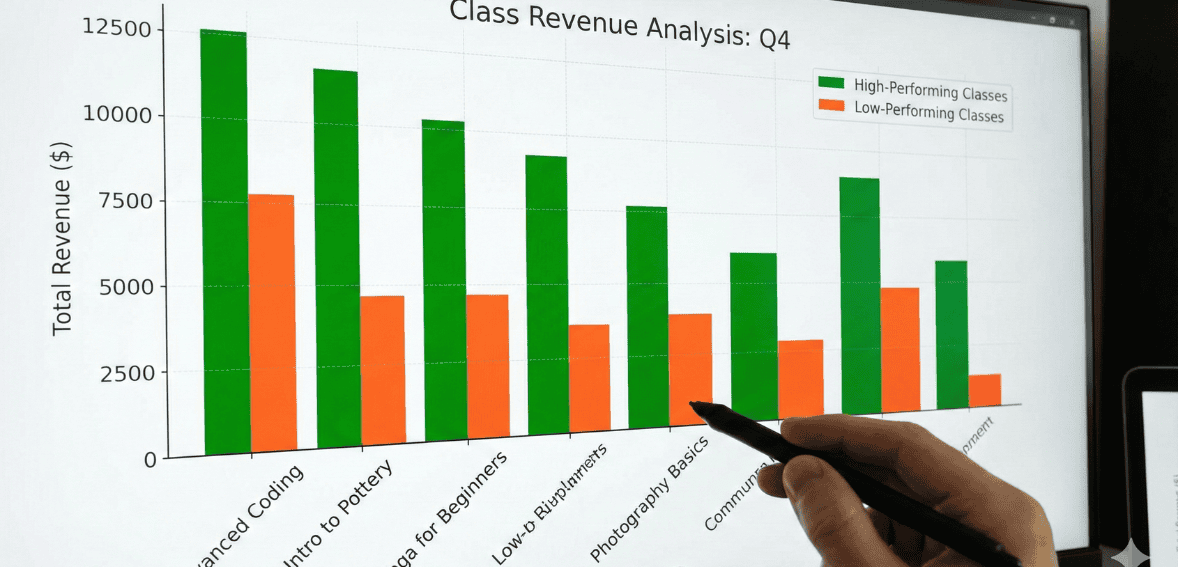
Revenue Per Class helps you see which sessions support your business and which quietly drain resources. If a class is consistently underperforming, you don’t panic.
- Try rotating instructors to boost energy.
- Shift class timing by 30–60 minutes.
- Re-market it with fresh messaging.
- Temporarily reduce class capacity to create demand.
- Replace the format if clients aren’t responding.
Over time, your classes become intentionally placed, not simply scheduled out of habit.
Acting on Client Acquisition Cost (CAC)
High CAC tells you your marketing is costing more than it should. When you spot this trend:
- Pause campaigns that aren’t converting.
- Increase your focus on organic channels and referrals.
- Review whether your trial offer is attracting the right clients.
- Check if ads are reaching your target demographics.
Low CAC? That means your messaging is landing perfectly. Double down on those channels and amplify what’s working.
Acting on Net Promoter Score (NPS)
A drop in NPS is emotional before it becomes operational. It means something about the member experience is not matching expectations:
- Instructors may feel inconsistent.
- New clients may not be receiving guidance.
- Maybe facilities feel neglected.
- The check-in process may be cold.
When NPS rises, though, it is one of the strongest predictors of word-of-mouth growth. It signals that clients feel proud of the experience you provide and they’re talking about it.
Acting on Class Fill Rate
Fill rate is a mirror that shows how effectively your schedule aligns with your members’ lives. When fill rate dips:
- Check time slots that consistently underperform.
- Examine whether specific instructors have variations in attendance.
- See whether seasonal patterns affect class types.
- Experiment by moving a class into a neighboring time slot to recover attendance.
When does the fill rate rise? It’s a reflection of strong scheduling decisions and aligned demand.
Acting on Cancellation Lead Indicators
This KPI gives you time. Time to intervene. Time to save a membership.
Before a cancellation happens, behavior changes:
- Fewer check-ins
- Longer gaps between visits
- Freeze requests
- Reduced class engagement
- Declining attendance streaks
When the dashboard shows these early signals, you step in:
- Send a personal “we miss you” message.
- Offer a complimentary consultation to understand their goals.
- Invite them to a special class or member event.
- Remember their progress and win.
Preventing cancellations is far more profitable than replacing members and far more human.
Building Your Morning Dashboard Routine
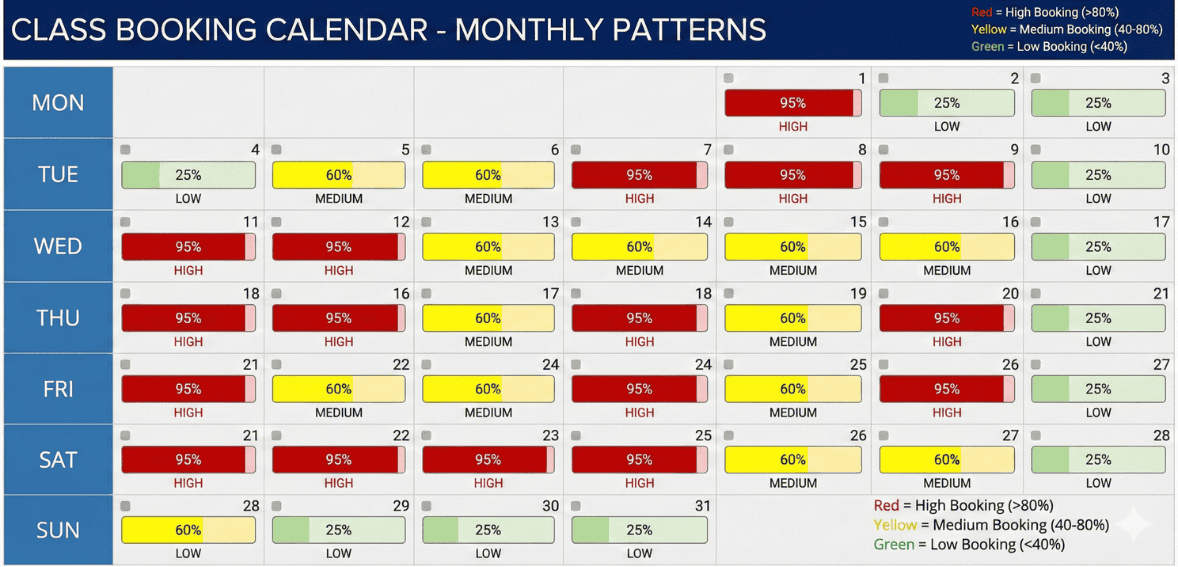
A dashboard shouldn’t feel like an overwhelming firehose of numbers. It should feel like a daily grounding moment, a short, simple check-in that prepares you for any minor adjustments you need to make throughout the day.
Studio owners who thrive treat their dashboard as part of their leadership ritual. It’s like brushing your teeth: it takes a few minutes, but the results compound over time. Consistency is what makes an owner truly data-driven.
Here’s how to build your 15-minute morning dashboard routine in a natural, human way that avoids burnout or analysis paralysis.
Step 1: Scan the Patterns (3 minutes)
You’re not diving deep yet you’re just getting a sense of direction.
Look for anything that looks noticeably different from yesterday or last week.
- Attendance up or down
- Fill rate rising or falling
- NPS stable or dipping
- CAC spiking unexpectedly
- A sudden drop in class performance
This creates your “mental map” for the day.
Step 2: Prioritize the Top Two KPIs (5 minutes)
Instead of trying to fix everything at once, you choose the two most essential signals from today.
Maybe attendance dipped. Your CAC suddenly increased. Cancellation indicators spiked. Revenue per class weakened.
You don’t chase 10 problems. You solve two small but important ones, which is how long-term improvement happens.
Step 3: Take Micro-Actions (5 minutes)
Data only matters when you use it.
- Send outreach messages to 3 low-attendance members.
- Review one underperforming class.
- Pause one weak ad.
- Talk to one instructor about client feedback.
- Check in with one member who looked at cancellation options.
Small actions done daily beat massive actions done inconsistently.
Step 4: Close the Dashboard and Move Forward (2 minutes)
You don’t obsess. You don’t stare at numbers all day. You don’t wait until everything is perfect.
You use data to make better decisions and then you get back to running your studio.
When you keep your morning routine simple, you stay consistent. And consistency is the real superpower behind a data-driven studio.
Conclusion
Boutique studios thrive when passion and data collaborate. Your coaches bring energy, your community brings spirit, but data brings direction. Tracking fitness studio KPIs daily isn’t a dry business habit, it’s the most straightforward way to protect your revenue, improve your client experience, and stay adaptable in a competitive industry.
With just 7 KPIs, you gain visibility into retention, attendance, revenue performance, client satisfaction, marketing efficiency, and early cancellation risk. This clarity allows you to make calm, confident decisions every day. You no longer guess. You no longer hope. You act.
And with a simple 15-minute dashboard routine, your entire business becomes sharper, steadier, and more strategic. Data doesn’t replace your passion but it strengthens it. And in boutique fitness, that combination leads to sustained growth, stronger communities, and studios that clients never want to leave.
Selecting a studio management tool is less about ticking boxes on a comparison chart and more about choosing a partner that invisibly choreographs the many moving parts of a modern wellness business. A simple, cloud-first interface welcomes staff of all tech backgrounds; customizable forms and conflict-free scheduling smooth every client’s entry; automated billing and flexible workflows keep revenue secure while letting programming evolve; rich integrations and data insights sharpen strategy; and mobile access ensures the studio heartbeat continues even outside its walls.
FAQs
What’s a healthy member retention rate for a boutique fitness studio?
Most boutique studios land between 71% and 85% annually. A rate below 70% may signal service gaps or weak client engagement. Retention improves through community building, strong onboarding, consistent coaching, and habit-reinforcing follow-up.
How do I calculate member lifetime value (LTV)?
Use: average monthly revenue × average months retained. Higher LTV means clients stay longer and spend more, allowing you to invest confidently in acquisition. Improving retention, upsells, and coaching quality boosts LTV.
What’s the difference between leading and lagging indicators?
Leading indicators predict future outcomes (attendance consistency, engagement). Lagging indicators confirm what has already happened (cancellations, lost members). A healthy dashboard uses both for accurate forecasting.
Should different membership types have separate KPIs?
Yes. Unlimited members, class packs, and drop-ins behave differently. Virtual vs. in-person members also show different attendance and engagement patterns. Segmentation prevents misleading averages and reveals actual patterns.
What automated reports should studio software provide?
Daily snapshots, weekly class attendance, monthly revenue, retention summaries, and churn risk reports. These help you monitor trends quickly and respond before problems grow.