


The shift toward hybrid fitness isn’t temporary; it’s a structural change in how people engage with movement, accountability, and community. Every boutique studio now faces the same question: How do we offer virtual and in-person classes without hurting revenue?
It sounds simple at first. Add virtual classes, increase reach, diversify formats. But in practice, hybrid models create a delicate economic balance. The price for virtual access is too low and cannibalizes in-person membership. Price it too high and no one signs up. Blend both without intention and you end up confusing members, undervaluing your instructors, or leaving money on the table.
A thoughtful hybrid fitness studio pricing strategy requires more than comparing two numbers. It requires an understanding of cost structures, perception of value, behavioral patterns, and how members actually experience fitness across different delivery methods. Studios that get it right generate predictable revenue, higher retention, and a more resilient business model. Studios that get it wrong often face membership erosion, underutilized classes, or pricing structures that work against them.
This article breaks down the core elements of hybrid fitness economics through a practical, human lens not promotional or theoretical, but grounded in the real operational realities studios face every day.
Understanding the Financial DNA of Hybrid Fitness Models

Before setting any prices, a studio needs clarity on what actually costs money, what scales well, and what impacts profit margins across virtual and in-person formats. Many owners assume virtual classes should simply “cost less,” but the economic picture is far more nuanced.
Capacity limits define in-person classes. Every class has a hard revenue ceiling because only a certain number of bodies fit in the room. On the other hand, virtual classes behave like digital products. One instructor can serve twenty or two hundred members with nearly identical effort.
Effective studio financial management in 2025 requires the adoption of cloud solutions to streamline operations, improve collaboration, and gain better financial visibility. With cloud tools, studios can automate key tasks like invoicing, expense tracking, and reporting while ensuring seamless integrations with other business systems. This will not only help in reducing manual errors but also contribute to better decision-making, cost control, and scaling of the business to achieve new heights.
But virtual delivery isn’t free. There are hidden costs:
- Platform subscriptions
- Streaming or recording equipment
- Video storage
- Increased customer support load
- Digital content management
- Additional branding or editing work
The most sustainable hybrid fitness studio pricing strategy evaluates both formats not just by cost, but by value, scalability, and behavioral impact.
In-Person Economics: High Touch, High Cost, Limited Capacity
In-person classes carry:
- Rent or mortgage
- Front desk staffing
- Utilities
- Equipment wear
- Cleaning mandates
- Instructor rates (often higher for in-studio work)
This means in-person experiences must command premium pricing because the operational load is heavier. People don’t pay more simply because of physical presence, they pay more because the environment, equipment, and personal connection create value that is hard to replicate digitally.
Virtual Economics: Scalable but Not Costless
Virtual classes eliminate many overhead costs but introduce digital ones. A virtual-only membership, therefore, shouldn’t be priced as a “discount alternative” it should reflect:
- Unlimited scalability
- Lack of physical resource limitations
- Desire for flexibility
- Competitive online fitness landscape
- Ability to serve global audiences
A strong hybrid fitness studio pricing strategy acknowledges that virtual products may have lower marginal costs but can still deliver high value. Pricing must honor that value rather than racing to the bottom.
Why Cannibalization Happens (and How to Stop It Before It Starts)

Cannibalization happens when virtual classes unintentionally reduce in-person attendance or when members downgrade from premium-tier packages to cheaper virtual options. This occurs when pricing decisions don’t reflect the emotional and experiential differences between the two formats.
Members often compare cost-to-convenience:
- “If virtual is $39 and in-person is $159, why would I keep in-person?”
- “If I’m busy this month, virtual is enough I’ll downgrade.”
- “Why pay more when I can get the same workout at home?”
Studios can prevent this drift by designing packages that reinforce the unique benefits of each experience.
Understanding Consumer Perception Is Key
Most people don’t evaluate fitness pricing purely through logic; they do it through feelings. They ask themselves:
- “What do I get?”
- “Do I feel connected here?”
- “Is this worth rearranging my life for?”
- “Do I enjoy in-person culture?”
If virtual access feels “almost the same,” members gravitate toward the cheaper option.
An innovative hybrid fitness studio pricing strategy makes each format feel intentionally different, not interchangeable.
Pricing Should Reward In-Studio Engagement
In-person attendance drives:
- Stronger community bonds
- Higher retention
- Deeper brand loyalty
- A higher average lifetime value
That means members who show up physically should feel like they’re receiving a richer membership because they are.
This doesn’t mean making virtual inferior. It means making it unique in person.
Examples (not promotions, just educational):
- Members who attend in-studio gain priority booking, early access to specialty classes, community events, or instructor feedback.
- Virtual-only members get flexibility and accessibility, but not the same “studio privilege.”
This difference reduces the risk of downgrades and protects revenue.
Membership Tier Architecture: Designing Tiers That Work With Human Behavior
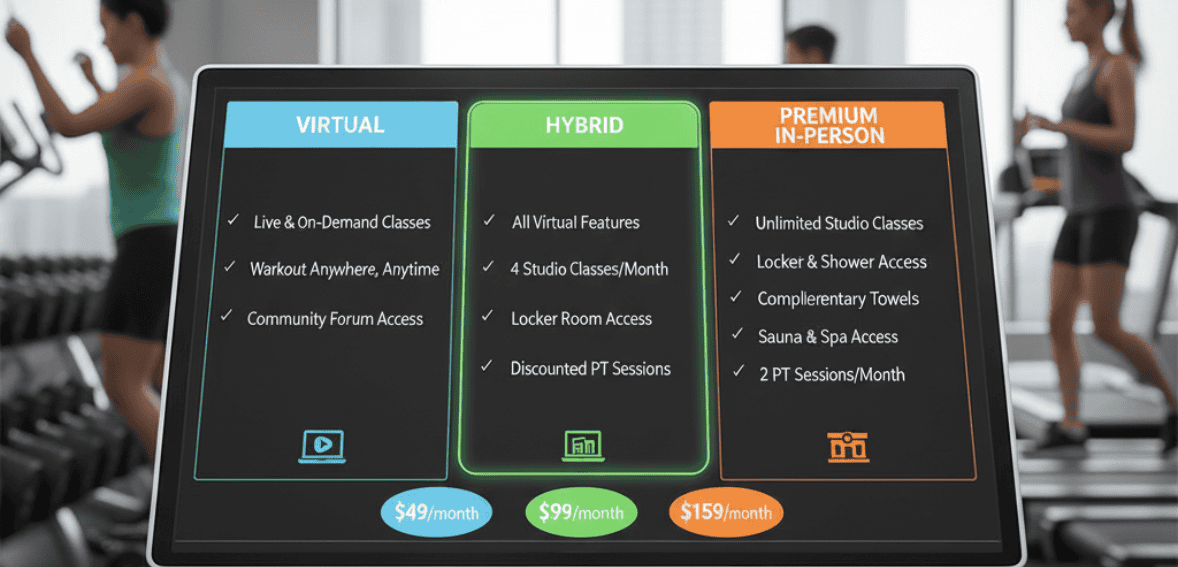
Pricing is not just math; it’s architecture. The most successful studios are not those with the cheapest options, they’re the ones whose options guide behavior intentionally.
A sustainable hybrid fitness studio pricing strategy includes at least three core tiers:
Virtual Access Tier
Designed for:
- Remote members
- Travelers
- Those who want flexibility
- People who value convenience over atmosphere
It should be priced to reflect high value, not “discount fitness.” Underpricing this tier leads to downgrades, which hurt revenue.
Hybrid Tier
The bridge between worlds virtual for flexibility, in-person for connection.
This tier is usually the best-performing option in hybrid studios because:
- It offers variety
- It reduces friction
- It encourages more frequent interaction
- It attracts busy professionals
This tier should sit strategically close to the in-person price, so upgrading feels natural.
In-Person Unlimited (Premium) Tier
The studio’s flagship membership.
This price must:
- Honor the limited capacity of in-person seats
- Reinforce premium value
- Shape the brand identity
- Sustain instructor and facility costs
These tiers help prevent the “downgrade spiral,” in which members slip into cheaper memberships and disengage.
Without a strong tier structure, studios struggle to establish a hybrid fitness studio pricing strategy that protects long-term revenue.
Virtual Class Pricing for Gyms: Why Cheaper Isn’t Always Smarter

There is a temptation to set virtual classes at a low price because they cost less to operate. But low pricing can create unintended consequences:
- It signals a lower value
- It attracts low-commitment members
- It positions virtual as a “budget option” instead of a legitimate offering
- It makes hybrid upgrades harder
- It conditions people to expect freebies or inexpensive streaming
An innovative hybrid fitness studio pricing strategy avoids positioning virtual access as a discounted substitute for in-person access.
Understanding Value-Based Pricing
Virtual fitness pricing should reflect:
- The instructor’s skill
- The studio brand
- Exclusive content
- Specialized formats
- Community features
- Library or replay access
- Consistency and structure
Virtual is not simply a cheaper version of in-person it is a different product entirely.
When priced in line with its value, studios build stronger digital audiences, not accidental cannibalization.
In-Person vs Online Fitness Membership Cost: How Member Experience Dictates Pricing

Many studios struggle because they price based solely on cost. A more effective approach is to price based on member experience. Ask:
- Where do members feel the highest connection?
- Which experiences drive routine, accountability, and a sense of cultural belonging?
- Which touchpoints influence retention?
In-person fitness still leads to emotional connection. It delivers:
- Social energy
- Instructor feedback
- Accountability triggers
- Ritual and atmosphere
- Group belonging
This means in-person pricing must always sit at the top of the hierarchy.
Meanwhile, virtual access appeals to:
- Flexibility
- Travel schedules
- Introverted members
- Self-paced participants
- Convenience-driven lifestyles
Pricing should reflect these psychological patterns.
Studios that ignore experience-based pricing often struggle to maintain a healthy hybrid fitness studio pricing strategy because cost-based pricing overlooks what members actually value.
Fictional Case Studies: How Realistic Studios Use Hybrid Pricing Without Losing Revenue

Sometimes, the most straightforward way to understand a hybrid fitness studio’s pricing strategy is to observe how it plays out in real-world situations. While these examples are fictional, the numbers and behaviors are modeled after realistic industry patterns seen across boutique studios.
Case Study A: The Barre Loft – Preventing Virtual Downgrades
The Barre Loft, a mid-sized barre studio with 140 active members, introduced virtual classes during a slow winter season. They launched a $49 virtual membership that included unlimited livestream access.
Within 60 days, they saw:
- 21 members downgrade from in-person to virtual
- 14 members are attending fewer classes overall
- A drop in studio energy during peak sessions
The problem was not virtual supply. It was misaligned pricing.
What They Changed:
They implemented a new tiered hybrid fitness studio pricing strategy:
- Virtual Access → $79
- Hybrid (8 in-person + unlimited virtual) → $129
- In-Person Unlimited → $159
The small price gap between hybrid and unlimited pushed people naturally toward the higher-value tier.
The Result:
- The hybrid became the most popular tier
- Downgrades reversed
- In-person participation stabilized
- Revenue increased despite fewer total members on the unlimited plan
This case shows that pricing isn’t about cost, it’s about guiding member decisions toward business sustainability.
Case Study B: Core Flow Yoga – Maintaining Studio Culture in a Hybrid System
Core Flow Yoga had the opposite issue. When they launched virtual memberships at $99/month, they feared people would abandon the physical studio. But instead, they found that virtual-only members were unengaged and rarely converted to in-person classes.
Why This Happened:
Virtual-only lacked structure:
- Unlimited videos
- No scheduled livestreams
- Little instructor interaction
- No community moments
- No accountability
Virtual members floated in and out without a sense of belonging.
What They Implemented:
Core Flow redesigned its hybrid fitness studio pricing strategy to include:
- Small-group virtual classes
- Personalized accountability check-ins
- Virtual challenge programs
- Two “in-studio required” events per month
They also adjusted pricing:
- Virtual Access → $89
- Hybrid → $149
- In-Person → $169
Outcome:
- 25% of virtual members upgraded
- hybrid members attended more frequently (virtual + in-person)
- Online-only churn dropped
- Community cohesion improved
This example demonstrates how hybrid structures require intentional engagement not just passive access.
Case Study C: Strength Box – Making Virtual Profitable for a Small Studio
Strength Box was a small 40-member strength training studio. They feared virtual classes would cannibalize their already limited in-person capacity. Instead, virtual access became a revenue multiplier.
Strategy Used:
- In-person remained the core offering
- Virtual became an add-on, not a separate membership
- Hybrid tiers pushed members toward both formats
Their hybrid fitness studio pricing strategy looked like:
- In-Person Unlimited → $189
- Add-On Virtual → +$29
- Hybrid Tier (Unlimited both) → $209
Outcome After 6 Months:
- Virtual add-ons increased revenue by 18%
- The hybrid tier became the second-most purchased package
- No significant downgrades occurred
- In-person attendance remained healthy
Strength Box shows that virtual can serve as a value-add rather than a cheaper alternative.
Optimizing Revenue in a Hybrid Model

Studios often focus on pricing structure without considering behavioral economics. Proper optimization comes from aligning price with behavior.
The Pricing Ladder Approach
A strong hybrid fitness studio pricing strategy acts like a ladder:
- The lowest tier offers flexibility but limited benefits
- The middle tier provides the best value
- The highest tier provides the richest experience
Members climb or descend based on life circumstances. A good ladder makes upward movement natural and downward movement less appealing.
Anchoring & Price Psychology
Pricing should encourage the perception that:
- virtual alone is flexible
- The hybrid is balanced
- In-person is premium
Anchoring works when the highest tier makes the mid-tier feel like excellent value.
Example:
- Virtual → $89
- Hybrid → $139
- Unlimited → $169
Members see unlimited as only $30 more than hybrid, making it psychologically attractive.
This helps prevent revenue erosion.
Content Access Matters
Virtual content libraries must be managed carefully. If priced too low, they draw members away from in-person classes. If included only with hybrid or premium tiers, they strengthen the value of those packages.
Peak-Time Demand and Capacity Pricing
Hybrid models protect revenue when studios:
- Charge more for peak-time in-person access
- Offer cheaper virtual options for off-hours
- Limit studio capacity strategically
Revenue optimization isn’t about charging more, it’s about structuring value so the business doesn’t lose money when members choose virtual.
How Hybrid Pricing Affects Member Retention
Hybrid offerings influence more than revenue; they shape commitment behaviors.
Virtual Convenience vs In-Person Attachment
Virtual access increases flexibility, but flexibility alone doesn’t create loyalty. Emotional attachment does.
In-person experiences drive:
- Routine
- Accountability
- Community
- Social bonds
- Habit formation
Virtual experiences drive:
- Convenience
- Mobility
- Flexibility
- Accessibility
A strong hybrid fitness studio pricing strategy encourages members to maintain both types of engagement.
The Risk of Virtual Isolation
Members who rely purely on virtual can drift faster because they lose:
- Personal interactions
- Instructor recognition
- Community energy
- Ritual and routine
This is why hybrid tiers often produce the best retention they provide flexibility without letting members detach entirely.
Retention Improves When Pricing Reflects Behavior
Pricing structures that reward consistency rather than underpricing for convenience directly improve retention.
Studios that design memberships around real behavior patterns see fewer downgrades and fewer cancellations.
Conclusion
The modern gym must operate at the intersection of digital and physical experiences. Pricing is no longer just about covering costs, it’s about guiding member behavior, protecting in-studio culture, and creating sustainable revenue streams.
A successful hybrid fitness studio pricing strategy recognizes the value of both delivery methods, honors the emotional differences between them, and structures pricing to encourage balanced engagement.
Virtual classes expand reach, but in-person classes build community. Hybrid memberships bridge the gap, allowing members to integrate flexibility with connection.
Studios that price intentionally not reactively are the ones that thrive in a hybrid landscape. When pricing aligns with behavior, psychology, and long-term engagement, the hybrid model becomes more than a survival tactic. It becomes a competitive advantage.
FAQs
Should virtual classes cost less than in-person classes?
Not always. Pricing should be based on perceived value, not just operational cost. While virtual delivery is cheaper, members often value structured programming, coaching, and accountability. Value-based pricing allows virtual and in-person to coexist without devaluing either.
How do I prevent virtual members from never coming to the studio?
Create membership structures that encourage in-person participation. Examples include hybrid tiers that require in-person check-ins or special events, and workshops or assessments that require physical attendance.
What’s the ideal ratio of virtual to in-person members for a boutique studio?
Most boutique models operate best with 70–80% in-person members. This maintains community culture and ensures the physical space remains vibrant. Virtual members add revenue, but a strong in-studio base supports long-term retention.
Can a small studio make money from virtual classes?
Yes, if virtual offerings are structured correctly. Profitability comes from scalable programs, livestream consistency, and integrating virtual as an add-on or hybrid tier rather than a low-value standalone membership.
How does hybrid pricing affect member retention rates?
Hybrid memberships often produce stronger retention than virtual-only or in-person-only structures. Flexibility reduces drop-off during busy times, while in-person access maintains emotional attachment. Balanced pricing keeps members engaged with both formats.